
Audit Glow and Shaking Hands: When Spellcraft Is Desire
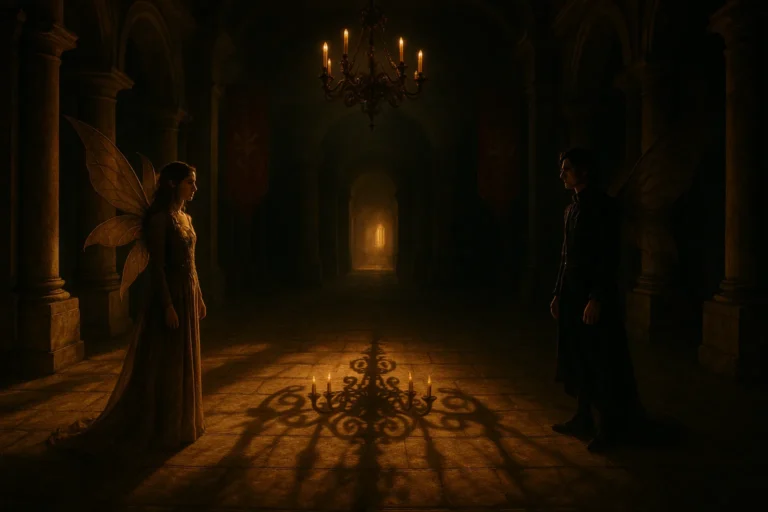
Sable Veyrath is the reason I can’t stop thinking about Dark & Fae’s spellcraft. Not because he explains it. Because he *uses* it like a weapon he’s barely willing to unsheathe, and every time his channeling collides with the bureaucratic infrastructure of the Umbral Courts, I feel the walls closing in on the [enemies-to-lovers arc](https://romantasyrefuge.com/enemies-to-lovers-trope-guide) that’s already suffocating me in the best possible way. He doesn’t monologue about how the ley-lattice networks function. He grips one, channels it through an artifact that shouldn’t respond to him, and the woman he’s not supposed to want watches his hands shake with the cost. That’s when the power system works. That’s when it’s gorgeous.
And then there are pages where it doesn’t.
That line between gorgeous and tedious is exactly where Dark & Fae lives, because this franchise sits squarely in a category of romantasy that readers are fighting about in every comment section right now: techno-arcane hybrid spellcraft. Power that doesn’t just exist as wild, instinctive force but gets tangled up with institutions, artifacts, networks, quasi-scientific rules, and the kind of structured architecture that feels one flowchart away from losing its soul. This franchise does it better than most. But “better than most” isn’t the same as flawless, and the places where it stumbles are exactly the places where every romantasy reader has an opinion they’ll defend with their whole chest.
Why Hybrid Fae Spellcraft Hits Different in Romance

The thing about techno-arcane power in a romance-forward series is that the framework can never just be clever. It has to be emotionally consequential. Readers in this space aren’t evaluating whether the author built a logically airtight infrastructure. They’re evaluating whether the spellcraft makes the kiss more desperate, the betrayal more devastating, the power imbalance more intoxicating. Dark & Fae’s system, at its best, does exactly this.
The Umbral Courts run on a blend of raw fae power and institutional architecture: ley-lattice networks that function like energy grids, artifact registries controlled by court bureaucracies, tiered access to spell channels based on rank and bloodline. It’s not soft. It’s not hard in the rules-first, spreadsheet-your-spells sense either. It’s something messier and more interesting: a framework where the rules exist but the characters interact with them the way real people interact with any structure of power. They game it. They suffer under it. They break it for each other.
Sable’s arc is the clearest example. He’s locked out of the higher lattice tiers because of his bloodline status, which means every time he accesses power he shouldn’t have, it costs him something physical. His body pays for what the bureaucracy won’t authorize. And when Elara, the woman assigned to audit his compliance (yes, *audit* — the tension writes itself), starts noticing the physical toll on him, the spellcraft stops being worldbuilding and becomes foreplay. The tension isn’t “how does this spell work.” The tension is “what will this spell take from him, and will she care enough to stop him.”
This is the sweet spot — where hybrid spellcraft earns its place in a romantasy, where the power system and the heartache are the same breath.
The Moment Spellcraft Starts Reading Like a Manual
But Dark & Fae doesn’t always hold that tension, and the moments where it drifts are instructive for anyone trying to understand why readers react so viscerally to pacing around worldbuilding.
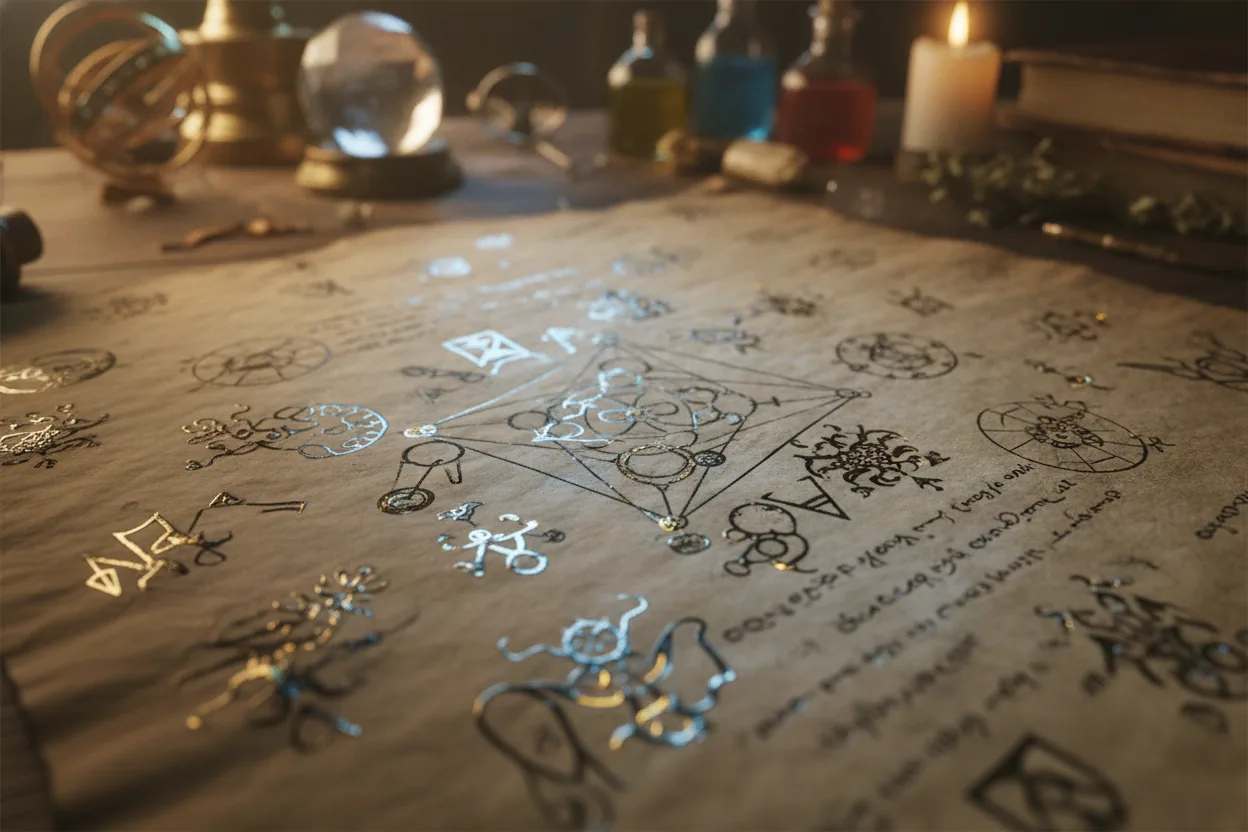
There’s a stretch in the second book where the narrative stops to explain the seven-tiered lattice classification in detail. Full detail. How each tier corresponds to a different frequency of ley energy, how artifacts are rated for compatibility, how the Registrar’s office tracks unlicensed spell usage through resonance signatures. It’s thorough. It’s internally consistent. It’s also about four pages where I completely forgot that Sable and Elara were standing in a room together and hadn’t touched yet even though the previous scene ended with him pinning her wrist against a ward-locked door and whispering, “You want to report this too?”
That line. That *line*. And then four pages of lattice taxonomy.
The community reaction to this exact section has been loud. The BookTok discourse around the lattice dump spawned its own micro-debate — creators like the ones running the “romantasy pacing crimes” threads split right down the middle: one camp arguing the detail makes the world feel real and grounded, the other arguing that no amount of lattice classification matters if it kills the momentum between two characters who are clearly about to either fight or kiss. Both camps are right, which is what makes this such a fascinating tension point. The question isn’t whether the worldbuilding is good. It’s whether it’s *placed* well. Whether it serves the emotional arc or interrupts it.
Readers in romantasy and adjacent [fantasy communities](https://romantasyrefuge.com/fantasy-worldbuilding-guide) keep coming back to the same principle: spellcraft should feel coherent, emotionally legible, and story-serving. Not fully diagrammed. Dark & Fae’s system is all of those things when it’s filtered through character experience. It stops being those things when the narrator steps back and starts teaching.
Rule Hints Beat Rule Books Every Single Time

The strongest sections of Dark & Fae’s worldbuilding are the ones where you learn the rules by watching them matter. Elara’s audit power, for instance, is never formally explained in a dedicated exposition block. You learn what it does because you watch her use it. She touches an artifact and her fingertips glow with a cold, blue-white light that intensifies when the object’s been tampered with. She runs her hands along a lattice node and her breathing changes when she detects unauthorized channels. You understand the mechanics because they’re embodied. They live in her body, in her reactions, in the physical grammar of her interactions with the arcane infrastructure around her.
And because her gift is tactile and sensory, it becomes inherently intimate when she uses it on Sable. When she audits *him*. When her hands are on his chest and the blue-white glow flares hot because his body is running with power he’s not supposed to have, and they both know what she’s found, and neither of them moves.
That’s rule-hinting at its absolute peak. You understand that unauthorized lattice access is detectable. You understand that Elara’s gift makes her a human lie detector for arcane compliance. You understand that Sable is breaking the law. You understand all of this without a single paragraph of explicit exposition because the scene *is* the explanation. The rule and the romantic tension are the same thing.
Compare that to the Registry scenes in book three, where a secondary character explains how artifact bonding contracts work in a conversation that reads like a legal briefing. The information matters for the plot. But the delivery flattens the tone so thoroughly that by the time we get back to Sable and Elara’s arc, the atmospheric temperature has dropped ten degrees and it takes pages to recover.
How Fae Tension Lives Inside the Spellcraft
Here’s where it gets really specific to this franchise, and really specific to why the enemies-to-lovers trope works differently when the power system is hybrid and institutional.
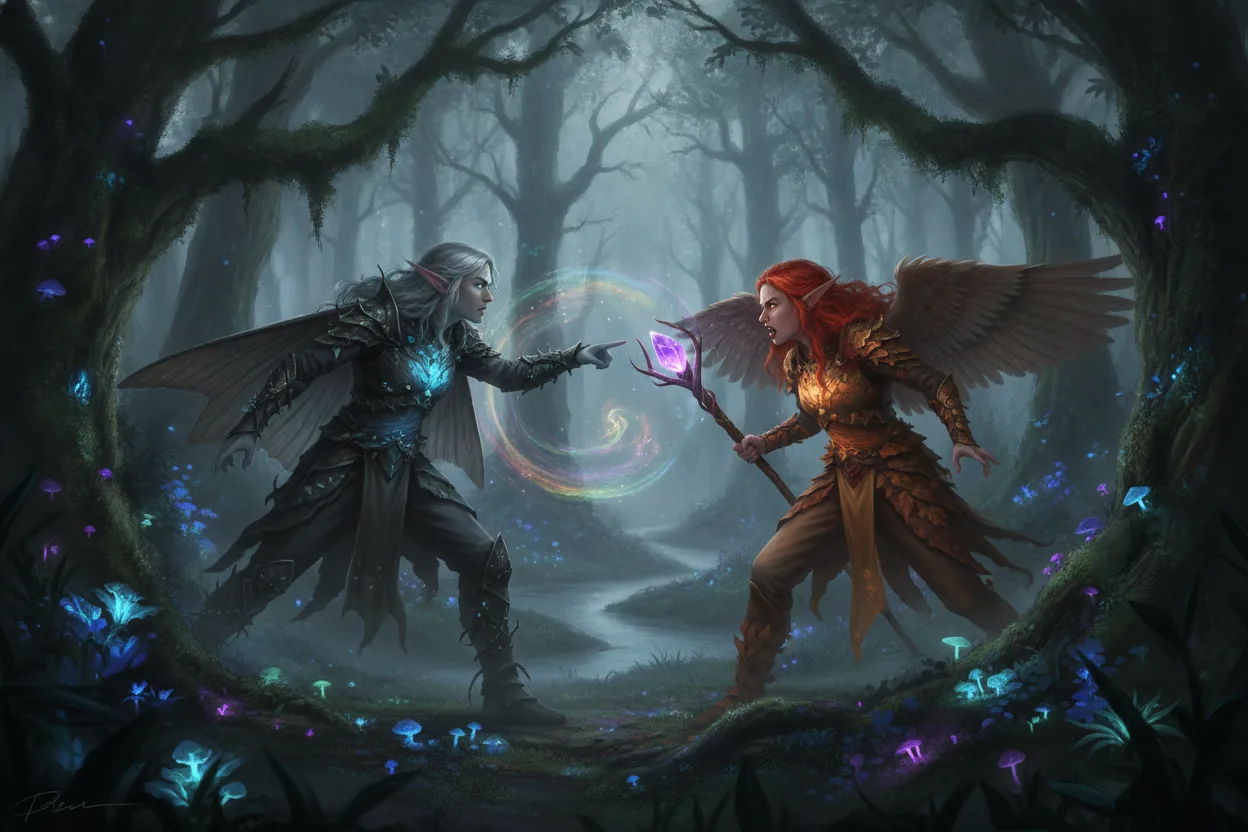
In a pure soft-magic romantasy, the rivals-to-romance tension is usually personal. Two characters hate each other because of history, pride, betrayal, competing loyalties. The spellcraft exists around them but doesn’t structurally create the opposition. In Dark & Fae, the framework *is* the opposition. Elara and Sable aren’t just enemies because of personal friction. They’re enemies because the world they both exist inside has placed them on opposite sides of a regulatory architecture. She enforces arcane law. He breaks it. Their entire dynamic is built by the techno-arcane infrastructure of the Umbral Courts.
This is what makes the trope hit harder in a hybrid framework. The tension isn’t just “I hate you but I want you.” It’s “the institution I serve says you’re a criminal, and every time I touch you my own gift confirms it, and I want you anyway, and wanting you makes me complicit.” That’s enemies-to-lovers with systemic stakes, where falling in love doesn’t just change how two people feel about each other but threatens the entire architecture of power they’ve both built their lives around.
The spicy line that lives in my head rent-free is from book two, when Elara finally confronts Sable about what her audits have revealed: “Every time I put my hands on you, I find another law you’ve broken. And every time, I write the report with your name redacted.” The look he gives her after she says this. The silence. The fact that she’s been protecting him using the very apparatus designed to destroy him. That’s techno-arcane romance at its most elegant, because the worldbuilding isn’t decoration. It’s the mechanism of the love confession.
The Trope Deep Dive: Opposition Through Institutional Spellcraft
Let’s name it properly. The trope operating here is regulatory enemies-to-lovers, which in its most specific form means two characters whose opposition is created or enforced by an institutional framework, and whose romantic arc requires one or both of them to betray that framework. The [MMF variation](https://romantasyrefuge.com/mmf-fae-court-series-recommendations), which Dark & Fae hints at in the subplot with Sable, Elara, and Kael (the lattice engineer who keeps “accidentally” leaving unauthorized channels open for Sable to use), adds a third axis of complicity. It’s not just “enforcer falls for criminal.” It’s “enforcer, criminal, and the guy who’s been quietly rigging the infrastructure to keep them both alive realize they’ve been orbiting the same gravitational center this whole time.”
The fae enemies-to-lovers moment that crystallizes this trope comes in the lattice chamber scene, and it earns its devastation because every specific detail has been seeded across two books. All three characters are present. The ley-network is destabilizing. Kael’s already bleeding from holding the channels open — nosebleed streaking down his chin, his fingers white-knuckled on the lattice node, doing the thing he’s always done quietly but now doing it in front of the woman whose entire job is to catch people doing exactly this. Sable’s hands are shaking the way they always shake when the cost is too high, and Elara’s audit glow is flooding the room blue-white, her power screaming at her that everything happening here is illegal.
She looks at Kael bleeding. She looks at Sable’s hands. She remembers — and the text doesn’t say this outright, but you feel it like a gut punch — every report she wrote with his name redacted, every infraction she buried, every time her own gift told her the truth and she chose him over the institution anyway.
She deactivates the containment protocol.
That’s the moment. Not a declaration of love. Not a kiss. A bureaucratic override that costs her everything she’s built, performed with full sensory awareness of what she’s destroying, because the spellcraft has made the cost legible to her in a way it wouldn’t be in a softer world. She *feels* the rules she’s breaking. Her audit glow doesn’t dim — it flares brighter, hotter, almost punitive, her own power punishing her for the choice even as she makes it. And she does it anyway.
Why does this wreck you worse than every other enemies-to-lovers payoff you’ve ever ugly-cried over? Because the spellcraft gave the betrayal weight. Without the techno-arcane framework, Elara’s choice is abstract — a vague sense of loyalty shifting. With it, her choice has physical, institutional, and arcane consequences that the reader has been trained to understand through two books of carefully embodied worldbuilding. The system didn’t just create the tension. It made the resolution *cost* something real. You feel it in Kael’s blood, in Sable’s trembling hands, in the blue-white light that won’t stop telling Elara she’s wrong even as every other part of her knows she’s finally right.
Top three similar tropes that scratch this same itch: forbidden power bond (where the connection itself is illegal or taboo within the world’s architecture), reluctant guardian (where one character is assigned to contain or control the other’s abilities and falls for them instead), and system-breaker romance (where falling in love requires dismantling or subverting the institutional framework both characters depend on). If any of those made your heart rate spike, check out our [fae romantasy roundup](https://romantasyrefuge.com/fae-romantasy-roundup) for more series that weaponize worldbuilding against your emotional stability.
Where Dark & Fae Readers Draw the Elegance Line
So where does the community actually land on whether Dark & Fae’s spellcraft feels elegant or over-explained? The answer, based on every reading thread, comment section, and annotated page photo I’ve tracked, is that it depends entirely on whether the information is delivered through character experience or through narrative exposition.
The audit abilities? Universally loved. Readers describe them as “intuitive,” “sensory,” “hot,” and “the reason I understand the whole world without trying.” The lattice classification breakdown? Polarizing at best, with even defenders admitting it slows the pace. The artifact bonding contracts? Generally considered the weakest worldbuilding element because they’re introduced through dialogue that reads as explanatory rather than dramatic.
The pattern is consistent with what readers across romantasy and fantasy communities keep articulating: they want to understand what power costs, what it can break, and why characters can’t just solve everything with it. They don’t want a manual. They want to feel the spellcraft through the characters’ skin, and Dark & Fae’s best passages do exactly that. Sable’s shaking hands. Elara’s audit glow flaring when she touches something compromised. Kael’s nosebleeds when he holds a channel open too long. These are physical, immediate, sensory consequences that communicate rules without stating them, and they’re the reason the system works as a romantic device rather than just a fantasy framework.
The franchise’s weakest moments are the ones where the author seems to lose trust in the reader’s ability to infer. When the narrative pauses to make sure you understand the classification tiers, it’s not adding clarity. It’s subtracting wonder. And in a genre where readers come for the ache, the tension, the devastating slow collapse of two people who shouldn’t want each other, subtracting wonder is the one thing you can’t afford.
Artifact Architecture and the Intimacy of Objects
Sable’s lattice key almost ruined me, and I need to talk about why.
It’s the unauthorized artifact he uses to access restricted ley channels, and it responds to his emotional state. When he’s calm, it channels cleanly. When he’s near Elara, it destabilizes. The implication, which the text never states outright but every reader has picked up on, is that his feelings for her are literally disrupting his ability to use power safely. His desire is a variable in the spellcraft. His want is a technical malfunction. That’s not just clever worldbuilding. That’s the arcane framework doing the romance’s emotional work, encoding the tension into the physics of the world itself.
There’s a scene in book two — quiet, almost throwaway — where Sable is alone in a lattice chamber, running a routine channel, and his key starts fluctuating. No reason. Elara’s not even in the building. But he’d seen her that morning, across the Registrar’s courtyard, and she’d looked at him the way she does when she’s deciding whether to be his auditor or his accomplice, and hours later his hands still aren’t steady and the artifact still won’t stabilize. He sits there in the dark, holding a piece of contraband that’s broadcasting his heartbreak in resonance frequencies, and he can’t make it stop. That scene doesn’t advance the plot by a single inch. It advances the love story by miles.
Elara’s audit tools react similarly. Her detection sensitivity increases around Sable, which she initially attributes to the volume of his infractions but which the reader understands, long before Elara does, as something else entirely. Her abilities are more attuned to him. Her body reads him more closely than it reads anyone else. The institution, the bureaucratic apparatus of arcane regulation, is telling her she’s drawn to him, and she keeps misreading the signal as professional diligence.
This is what makes techno-arcane romance work when it works. The framework doesn’t just create obstacles. It creates a language of desire that the characters don’t fully speak yet, and the reader gets to translate it in real time, decoding the love story through the [spellcraft infrastructure](https://romantasyrefuge.com/spicy-romantasy-reading-guide) before the characters catch up. That’s elegant. That’s the opposite of over-explained. That’s a system that trusts its readers to feel what it means.
The Only Rule That Matters for Romantasy Spellcraft
If Dark & Fae teaches us anything about the techno-arcane balance, it’s this: the power system serves the romance or it’s furniture. Every lattice tier, every artifact bond, every bureaucratic regulation, every quasi-scientific rule earns its place only when it intensifies what the characters feel, risk, or lose by loving each other. The moment the spellcraft exists for its own sake, the moment it demands attention that doesn’t pay off in emotional currency, it becomes the thing romantasy readers will skim past to get back to the scene where his hands are shaking and her glow is screaming and neither of them can look away.
Sable Veyrath is the reason I fell in love with this series. But the spellcraft is the reason the love story hurts. Because in Dark & Fae, wanting someone isn’t just forbidden by social convention or political rivalry. It’s detectable. Measurable. Encoded in the infrastructure of the world itself. And that means every time these characters choose each other, they’re not just breaking rules. They’re breaking a framework that can feel them doing it.
That’s the kind of power I want in my romantasy. Designed but not over-labeled. A little bureaucracy, a little mystical texture, and just enough structure that when the rules shatter, I feel it in my chest.
And somewhere in the back of my mind, I still hear Sable’s voice in the ward-locked doorway, Elara’s wrist under his hand, the ley-lattice humming with energy neither of them should be touching: “You want to report this too?” The silence after. The way she doesn’t pull away. The way her audit glow flickers — not brighter, not dimmer, but *warmer* — and they both pretend not to notice what that means.
That’s the whole series in one breath. The spellcraft knows. The characters aren’t ready. And the reader is already gone.