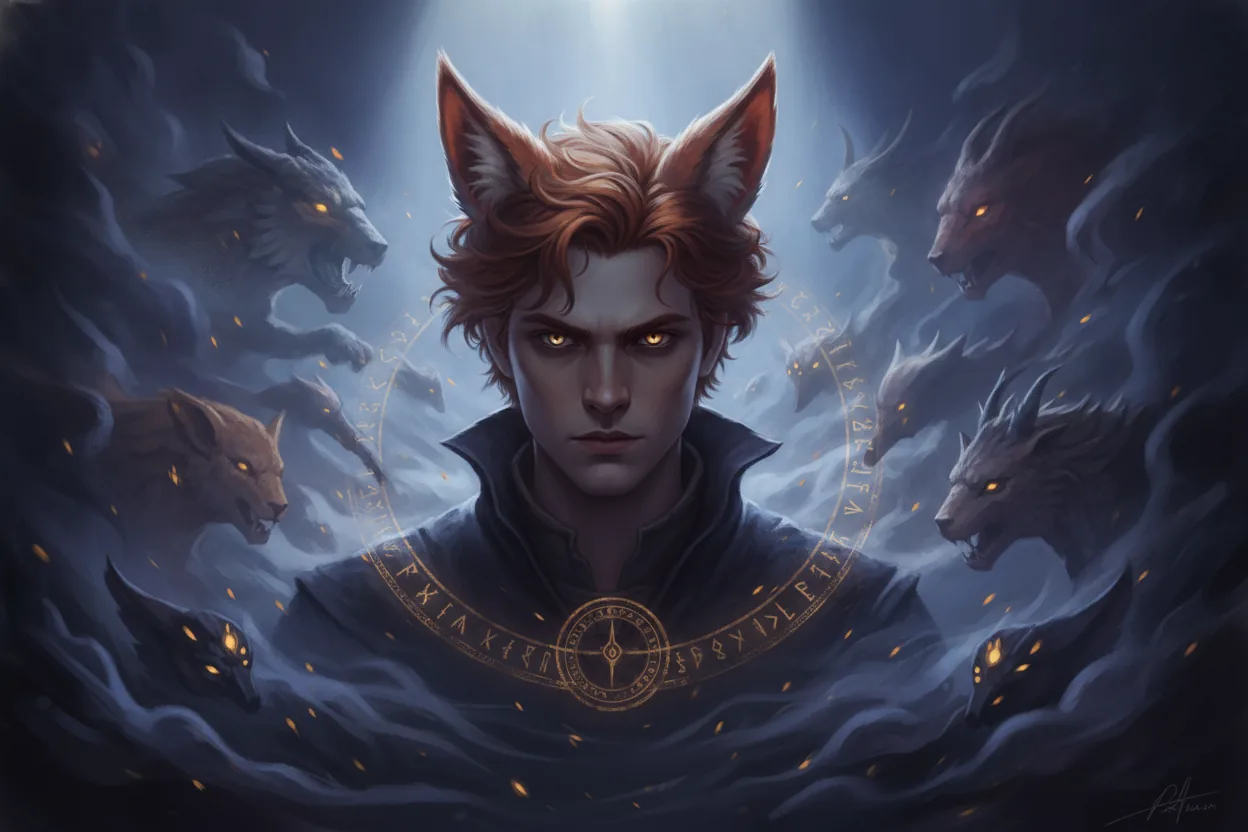
Lucien’s Fox Eye and the Theories Picking Every Lock
Lucien Vanserra is the reason I can’t let go of this universe.
Not because he’s the most powerful. Not because he gets the most page time. Because every single detail Sarah J. Maas has ever attached to him feels like a lock without a key, and the fandom has been picking that lock for years with nothing but breadcrumbs and spite. His fire, his fox eye, his bloodline that keeps getting rewritten by revelation, the way his mating bond sits there like an unexploded device across multiple books. Lucien doesn’t just invite fan theories. He generates them the way a fae court generates intrigue: constantly, quietly, and with just enough ambiguity to make you lose sleep over a single sentence on page 312.
And that’s exactly what this piece is about. Not Lucien specifically, though he’ll come back. This is about what happened when romantasy readers stopped passively consuming these massive fantasy romance universes and started treating them like crime scenes.
Breadcrumb Culture Didn’t Start on BookTok but It Lives There Now

There’s a specific moment in fandom evolution where readers go from “I liked that detail” to “that detail is evidence.” Romantasy hit that moment hard, and it didn’t just stay in niche Discord servers. It spilled onto TikTok threads, into podcast breakdowns, across Tumblr posts that read like legal briefs with fairy citations.
The word breadcrumb gets thrown around constantly now. Not as a metaphor. As a genre expectation. Readers don’t just hope Sarah J. Maas planted a deliberate micro-signal in that throwaway line about a tattoo in Crescent City that mirrors a wyrdmark from Throne of Glass. They expect it. They build spreadsheets around it. They pull quotes from three different series, line them up, and say *look, this recurring glyph isn’t decorative. It’s connective tissue. It’s a promise.*
This isn’t new behavior for fandoms in general. Marvel fans have been doing it for a decade. But romantasy fandom does it differently because the emotional stakes aren’t just lore-deep. They’re ship-deep. When you’re tracking a planted detail, you’re not just asking “does this symbol connect two worlds?” You’re asking “does this symbol prove that he was always meant for her?” That’s a fundamentally different kind of investigation. It’s forensic romance. It’s reading with a highlighter in one hand and your heart in the other.
The Micro-Clue Obsession Is Rewriting How We Reread

The fourth reread of *A Court of Mist and Fury* isn’t about plot. She could recite the plot while parallel parking. She’s rereading for texture. For the sentence she skimmed the first time that now, after reading *Crescent City* and revisiting *Throne of Glass*, lands like a thunderclap.
A protection symbol carved into a doorframe. A phrase spoken in the Old Language that appears in a different character’s mouth three books later. An amulet described with oddly specific detail in a scene that doesn’t otherwise need it. These aren’t plot points. They’re deposits. They’re tiny investments an author makes that only pay off if the reader is paying close enough attention, and the romantasy readership is paying attention at a level that borders on surveillance.
This is where fan-theory literacy becomes a real skill. Not everyone who spots a detail builds a good theory from it. There’s a massive difference between “this tattoo appeared twice therefore the characters are secretly related” and “this tattoo appeared twice, here’s the linguistic root of the symbol, here’s how it connects to the magic system’s rules, and here’s why its placement on this character’s body contradicts what we were told about their lineage in book two.” The second version is what the best [romantasy fan theories](https://romantasyrefuge.com) actually look like. They don’t just notice. They contextualize. They cross-reference. They stress-test.
And the discourse that follows? That’s where theories go to either get sharpened into diamonds or shattered into dust.
Cross-Series Callbacks Are the Real Battleground

The single most electrifying development in romantasy fan theory culture over the last few years has been the confirmed crossover. When Maas made it explicit that ACOTAR, Throne of Glass, and Crescent City share a connected multiverse, she didn’t just blow up her own narrative structure. She retroactively turned every ambiguous detail from every prior book into a potential clue.
Think about what that does to a readership that was already obsessive. Suddenly the wyrdmarks from Throne of Glass aren’t just cool worldbuilding. They might be the same language as the markings on a gate in Crescent City. Suddenly Amren’s true form isn’t just backstory. It might be connected to something we saw in a completely different series. Suddenly a random amulet in one book and a random amulet in another book aren’t coincidences. They’re a trail.
Fan theorists started building what I can only describe as universe maps. Not geographical maps (though those exist too). Conceptual maps. Webs of connection that track how a single motif — say a specific kind of star-related imagery — travels from one series to another, accumulating meaning as it goes. These maps aren’t official. They’re community-built. And they’re contested constantly, because one reader’s “confirmed callback” is another reader’s “interesting coincidence.”
This is where the real fun lives. Not in the moment of discovery but in the debate. Is this a planted signal or a coincidence? Did the author place this deliberately, or are we pattern-matching because human brains love patterns and romantasy brains love them more?
Theory Stress-Tests: The Content the Replies Actually Want

If you spend any time in romantasy discourse, you notice something fast. The most engaged threads aren’t recaps. They aren’t reviews. They’re arguments about evidence quality.
Someone posts: “The Dusk Court theory is basically confirmed because of the star map in HOFAS chapter 22.” And within minutes, someone else responds: “That’s a reach. The star map doesn’t match the constellation pattern described in ACOMAF. Here’s the page number.” And then a third person drops in with: “Actually, both of you are missing the real connection. Look at the language Bryce uses to describe the gate versus the language Aelin uses. The verb is the same. *The verb.*”
This is fan-theory literacy in action. It’s not a monologue. It’s a cross-examination. And the readers who engage at this level aren’t casual. They’re building arguments with textual evidence, citing page numbers, comparing translations, pulling up old interviews where the author said something that might or might not be a hint.
What they’re really doing is sorting clues into categories, even if they don’t name them explicitly. There’s the confirmed clue: the author has acknowledged it, or the text makes the connection undeniable. There’s the likely callback: the pattern is too specific and too repeated to be accidental. There’s the interesting coincidence: could mean something, could mean nothing, but it’s worth flagging. And then there’s the hard reach: the theory that requires you to ignore three contradicting details to make it work.
The best fan theorists know which category their evidence falls into. They build their cases accordingly. And they update in real time, revising when new books drop and old theories either get validated or vaporized.
Lucien Vanserra and the Theory That Won’t Die
Let’s come back to Lucien because he’s the perfect case study for how micro-clue obsession works at the character level — and because we owe him receipts.
The theory around Lucien’s true parentage existed long before it was confirmed in the text. Readers built it from scattered signals: the way his power didn’t match Beron’s fire, the way his physical description — that golden skin, those specific eyes — diverged from his red-haired brothers, the loaded silences in scenes with Lady Vanserra. The leading theory, whispered across Tumblr and Reddit for years, was that Helion, High Lord of the Day Court, was Lucien’s true father. The textual receipts were damning: Helion’s known affair with Lucien’s mother, the physical resemblance Maas kept drawing with suspicious precision, and the fact that Lucien’s magical abilities never quite fit the Autumn Court’s fire-wielding profile. When the reveal finally landed, it wasn’t a surprise for the theory community. It was a vindication. Months of forensic romance paid off in a single paragraph.
But here’s the thing about Lucien. The parentage theory was just the beginning. The theories that still burn hot are the ones about his future.
The top three right now break down like this.
First: Lucien is the key to whatever Elain’s seer powers are actually building toward. The mating bond between them isn’t a coincidence — it’s a structural necessity of the magic system. The evidence lives in how Maas writes fated bonds as load-bearing narrative architecture, never as decoration. In *ACOMAF*, the Cauldron chooses Elain and Lucien’s bond at the exact moment it also transforms her into a seer. Fans argue these two events aren’t separate. The bond and the sight are tethered. Lucien doesn’t just complete Elain romantically; he activates something. And the fact that Maas keeps them circling each other without resolution across multiple books? That’s not neglect. That’s a fuse.
Second: Lucien’s bloodline connects him to the Dusk Court theory. This one goes deeper than Day Court heir speculation. There’s a persistent fan theory that the solar and dawn imagery Maas attaches to Lucien — the gold, the blazing eye, the recurring light metaphors — doesn’t quite match Day Court aesthetics. Day Court imagery in the text skews warm and diffuse, like afternoon sun. Lucien’s imagery skews sharper. More like dawn. More like the edge between dark and light. Proponents of this theory point to the lost Dusk Court as a court that existed at the boundary between night and day, and argue Lucien’s mixed heritage might make him something more ancient than any current court recognizes. It’s a beautiful reach, but the textual pattern is specific enough to keep people digging.
Third: Lucien is being built as the bridge character for whatever Maas constructs next. His unresolved arcs outnumber anyone else’s in the SJM universe. He’s got cross-court relationships (Spring, Autumn, Day, Night), a dangling mating bond, a mechanical fox eye that fans are convinced has powers we haven’t seen yet (the persistent theory that [Beron suppressed Lucien’s abilities](https://www.reddit.com/r/acotar/) and the eye is either a seal or a replacement for something taken), and a diplomatic role that keeps putting him at the junction point of every major faction. The evidence here is structural rather than textual — it’s about where he stands in the web of alliances. No other character touches this many storylines without having their own book yet.
Each of these theories has its believers, its skeptics, and its stress-testers. And each one feeds on the same fuel: tiny details that might be nothing, or might be everything, and the intoxicating impossibility of knowing for sure until the next book drops.
The Spicy Dimension: When the Clues Lead to the Bedroom
Here’s something the theory discourse doesn’t always say out loud but absolutely runs on underneath. When readers track micro-clues in romantasy, they’re not just tracking lore. They’re tracking heat.
A repeated touch. A charged silence. A moment where a character’s magic flares in someone else’s presence and the text describes it with language that could be power or could be desire. These signals get cataloged just as carefully as wyrdmarks and amulets, because in romantasy, the magic system and the romance are inseparable. The bond is the magic. The magic is the bond. So when a reader spots a detail about how a character’s power responds to another character’s proximity, that’s not just worldbuilding analysis. That’s ship evidence. That’s proof that the tension is going somewhere.
In MMF fantasy romance specifically — and then it gets worse (better?) — when you’re tracking not just one romantic dynamic but two or three overlapping ones, the micro-clues multiply. A glance that lingers a beat too long between two characters who aren’t the “obvious” pairing. A moment of protective magic that flows in an unexpected direction. The way an author describes three bodies in a room and assigns agency and desire through tiny physical details: who moves first, who reaches, who holds back. These aren’t throwaway descriptions. They’re blueprints. And the readers who catch them feel like they’ve cracked a code.
This is why the enemies-to-lovers fae trope hits so hard in this kind of obsessive reading culture. Enemies-to-lovers is inherently a trope built on hidden signals. The hostility is the surface text. The attraction is the subtext. And the micro-clues that mark the transition from genuine animosity to reluctant want to devastating confession? Those are the planted details that keep readers up at three in the morning, rereading a single page because something in the way he said her name shifted, and she needs to figure out exactly when it shifted and what it means.
Why the Replies Are the Real Reading Experience Now
There’s a version of reading that’s solitary. You and the book. You and the page. That version still exists, obviously. But for the romantasy reader who’s deep in theory culture, the reading experience doesn’t end when the book closes. It migrates. It moves into the group chat, the podcast episode, the TikTok duet where someone holds up a highlighted passage and says “tell me this isn’t a callback to chapter fourteen of *Heir of Fire*.”
The discourse isn’t supplementary. It’s integral. It’s where your theory gets challenged and refined. It’s where someone points out the detail you missed, or reframes a clue you’d been interpreting wrong. It’s where consensus forms, fractures, and re-forms around new evidence. These threads function as the reading room of a library that only exists in collective attention, and the texts being studied are highlighted, dog-eared, and covered in Post-it flags that say things like “SUS” and “CALLBACK??” and “if this doesn’t pay off I will riot.”
Theory culture has become social performance, yes. But not in a dismissive way. In the way that all shared meaning-making is social. When a reader builds a theory, defends it in replies, revises it after a new book drops, and then watches it get confirmed or destroyed, that’s a complete narrative arc in itself. The reader becomes a character in her own story of interpretation. And the stakes feel real because the emotional investment is real. These aren’t hypothetical characters. These are the fae lords on her Pinterest board. These are the ships she’s defended in midnight threads. These are the breadcrumbs she followed through three series and six years of waiting.
What Separates a Good Theory from a Beautiful Reach
The honest truth is that not all romantasy fan theories are created equal, and the best theorists know this. A good theory starts with a specific, verifiable detail. It builds outward using consistent logic. It accounts for contradictory evidence rather than ignoring it. And it makes a falsifiable claim: if X happens in the next book, this theory is confirmed. If Y happens, it’s dead.
A beautiful reach, on the other hand, starts with a feeling. It builds outward using vibes. It ignores contradictory evidence because the emotional payoff of the theory is too good to let facts get in the way. And its claim is unfalsifiable: no matter what happens, the reach-defender can say “well, the author changed her mind” or “the real callback was thematic, not literal.”
Both kinds of theories have value. The good theory sharpens your reading. The beautiful reach deepens your attachment. The fandom needs both. The good theory gives you something to argue about. The beautiful reach gives you something to dream about. And the space between them is where romantasy fandom actually lives: not in certainty, but in the electric, maddening, deeply personal suspense of not knowing whether the detail you found is real.
That’s the thing about hidden clues in romantasy. They’re only clues if the author says they are. Until then, they’re faith. And faith, in a genre built on fated mates and impossible bonds and enemies who were always meant to fall, is the whole point.
You didn’t imagine that wyrdmark. You didn’t overread that tattoo. You didn’t waste your time building a theory from a single verb on page 247. You were doing forensic romance — reading the way this genre asks to be read: like every word is a door, and behind every door is another question, and behind every question is the devastating possibility that you were right all along.