She Burns the Kingdom Down and You Drag Her For It
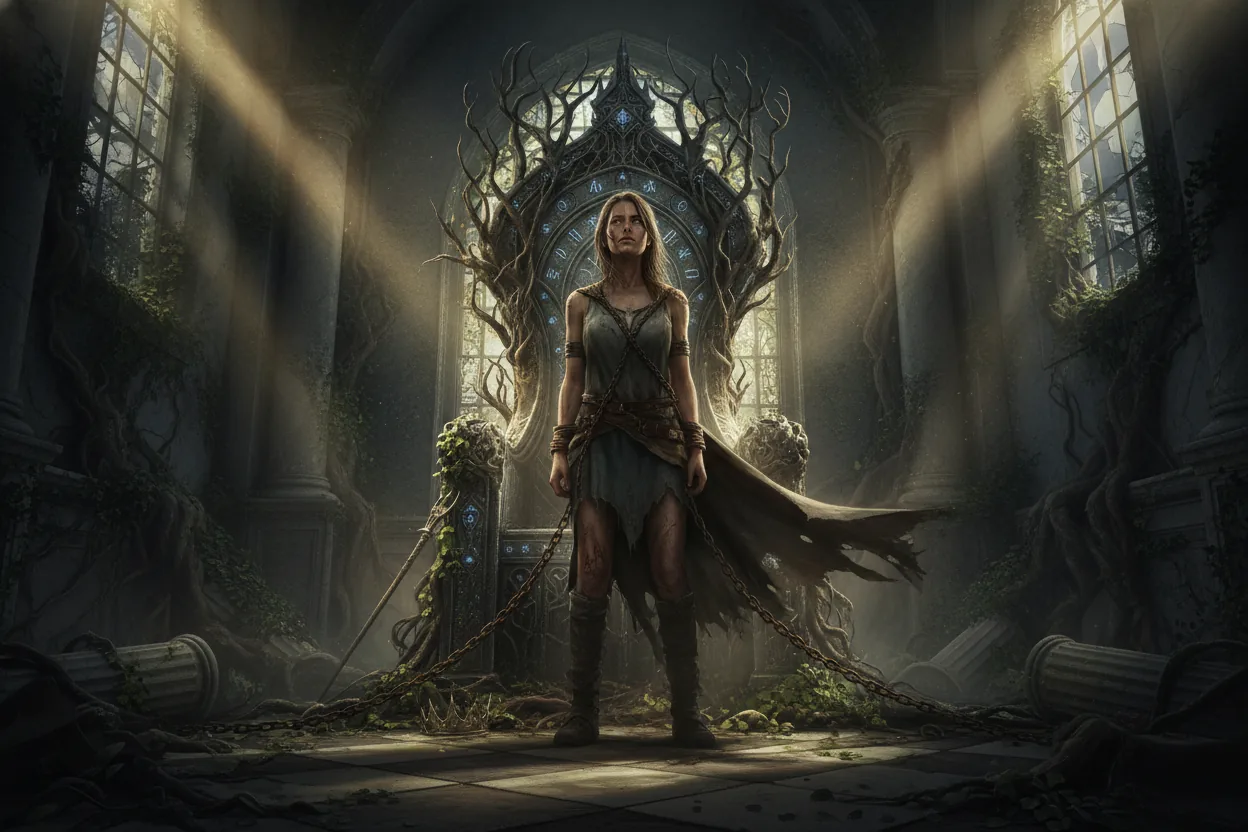
*She looked the fae lord who’d chained her to his throne room floor directly in the eye and said, “I’ll burn your kingdom down, and you’ll thank me for the warmth.”*
That’s not a quote from a published book. That’s a vibe composite — the kind of line that lives in a hundred romantasy openings, the energy that launches a thousand highlight reels. And I knew, reading lines like that across dozens of spicy fae romances, that I would follow this kind of woman into whatever catastrophe she was building. Because she wasn’t asking permission. She wasn’t performing strength. She was just on fire and refusing to apologize for the heat.
That’s always the line. The moment a heroine stops curating herself for your approval is the moment she becomes real enough to obsess over.
And that’s also the moment the messy FMC BookTok discourse detonates, comment sections splitting open like a cracked ward stone, everybody screaming about whether she’s iconic or insufferable while the fae lord stands there looking devastating and nobody says a word about *his* behavior.
The FMC Backlash Pattern Nobody Wants to Name

They are everywhere. Chaotic heroines splitting comment sections in half. And the discourse around them has stopped being about whether a character is well-written and started being about whether a woman is allowed to be difficult on the page without getting dragged for it.
You’ve seen the cycle. A book drops. The FMC is sharp-tongued, emotionally volatile, sexually forward, or just plain contradictory. She wants revenge and tenderness in the same breath. She pushes one love interest away and then crawls into his bed three chapters later — or pushes *both* of them away and then pulls them back in the same night. She makes choices that don’t serve a clean empowerment arc. And within seventy-two hours, the comments section becomes a war zone. “She’s so annoying.” “Pick-me behavior.” “I couldn’t root for her.” “She ruined the book.”
Not the pacing. Not the worldbuilding. Not the magic system that made zero sense. *Her.* Her personality. Her emotional register. Her refusal to be the version of a woman that makes everyone comfortable.
This is the pattern. And it’s not subtle. FMC backlash in romantasy has become a cultural tell — a pressure point where readers reveal, sometimes without realizing it, exactly what kind of woman they’re willing to tolerate in a story that’s supposed to center female desire.
Why “Unlikable” Became the Most Loaded Word in Messy FMC BookTok

Let’s talk about the word “unlikable” for a second, because it’s doing so much heavy lifting in BookTok reviews that it should be charging rent.
When readers call a heroine unlikable, they almost never mean she’s poorly constructed. They don’t mean her dialogue is clunky or her motivations don’t track. They mean she made them uncomfortable. She was too angry. Too selfish. Too sexually aggressive. Too soft when she should’ve been hard. Too hard when they wanted her soft. She didn’t perform the right kind of femininity at the right moment, and instead of sitting with that discomfort and asking why it exists, the reader flattens her into a label and moves on.
“Mary Sue.” “Pick-me.” “Too sassy.” “Cringe.”
Each of those phrases erases something specific. “Mary Sue” erases competence. “Pick-me” erases vulnerability and the desire to be chosen. “Too sassy” erases anger. “Cringe” erases sincerity. And every single one of them is applied to female characters at a rate that would be laughable if it weren’t so revealing. Because when an MMC is brooding and violent and emotionally withholding, he’s *complex*. He’s morally grey. He’s the dark romance antihero we pin to our boards at two in the morning. When an FMC does the equivalent — when she’s petty or manipulative or emotionally inconsistent — she’s the reason the book failed.
Look at the way BookTok creator [@eloise_reads](https://www.tiktok.com/@eloise_reads) broke this down in her viral stitch series on FMC double standards, cataloging side-by-side moments where Rhysand’s manipulation in *A Court of Mist and Fury* gets called “protective” while Nesta Archeron’s anger in *A Court of Silver Flames* gets called “toxic.” Same narrative universe. Same author. Wildly different tolerance from the same readership.
That asymmetry is the whole conversation. And romantasy readers who’ve been paying attention already know it.
The Disaster FMC Defense Is Not a Trend — It’s a Correction

Something shifted in the last year. You can feel it in the comment sections, in the BookTok stitches, in the way readers have started preemptively defending heroines they love before the backlash even arrives. “She’s messy and I don’t care.” “If you need your FMC to be likable to enjoy a book, this isn’t for you.” “She’s a disaster and I would die for her.”
This isn’t performative. This is readers recognizing that the standard applied to female main characters has been impossibly narrow for too long, and actively pushing back.
The chaotic heroine defense says something specific: that a woman on the page should be allowed to be as contradictory, as flawed, as morally complicated as the men she’s paired with. That “empowerment” doesn’t have to look like a girlboss montage. That softness and ruthlessness can live in the same body. That wanting to be dominated in bed and wanting to rule a kingdom are not contradictions. That a heroine who cries in one chapter and sets a court on fire in the next is not inconsistent — she’s human.
And this is where it gets interesting for romantasy specifically, because our genre lives and dies on emotional extremes. The entire engine of an [enemies-to-lovers arc](/trope-guide-enemies-to-lovers-romantasy) is contradiction. You hate someone. Then you want them. Then you hate that you want them. Then you’d burn the world to keep them. If we celebrate that arc in fae lords and shadow kings, we have to celebrate it in the women standing across from them. Otherwise we’re not reading romance. We’re watching women exist for the pleasure of the male character’s development, and that’s a different genre entirely.
The Heroine Who Cracked BookTok Open: Feyre, Bryce, and the Women We Can’t Agree On
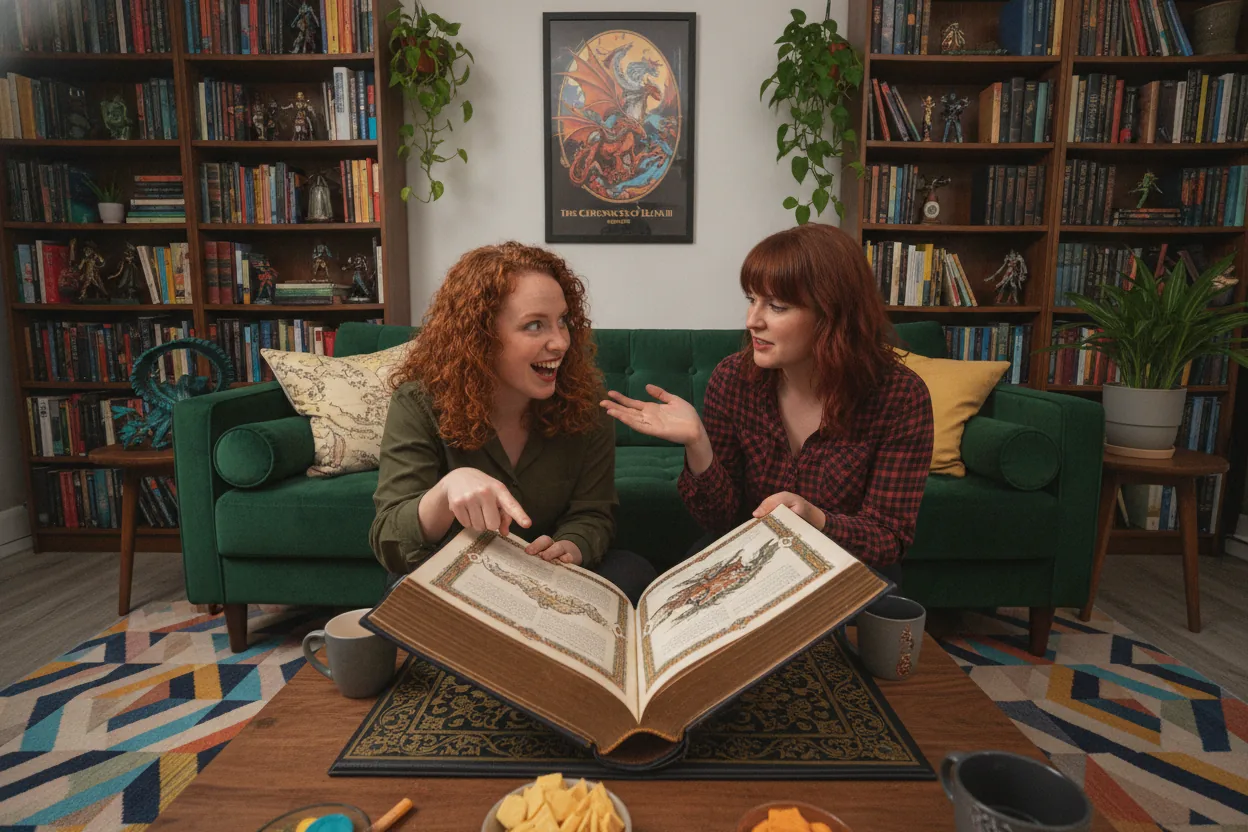
You can’t talk about FMC discourse without talking about the characters who became lightning rods for it. Feyre Archeron walked so every difficult woman on the page could run, and the discourse around her evolution from survival mode in *ACOTAR* to High Lady in *ACOWAR* is still one of the most revealing fault lines in the fandom. Readers who loved her early vulnerability turned on her when she gained power. Readers who wanted her powerful from the start found her early characterization weak. Almost nobody could agree on what she was *allowed* to be at any given moment, and the arguments were never really about Sarah J. Maas’s prose. They were about the woman. What she wanted. Whether her desires were legitimate.
Bryce Quinlan intensified everything. Bryce drinks. Bryce grieves loudly and messily and publicly. Bryce is sexual in a way that doesn’t center the male gaze. And the backlash was immediate and visceral. “She’s annoying.” “She’s too much.” “She’s not like Feyre.” As if Feyre was the ceiling and not the floor. As if one model of heroine was the template and everything else was deviation.
Then there’s Jude Duarte from Holly Black’s *The Cruel Prince*, who lied and schemed and clawed her way to a throne with blood under her fingernails, and the fandom worshipped her for it. Why? Because her messiness looked like power rather than emotion. Because her contradictions read as strategy rather than vulnerability. And that distinction matters, because it shows us which kinds of messy we’ll accept. Calculated messy. Cold messy. Messy that looks like a man’s version of ambition.
The unpolished FMC who’s messy because she’s overwhelmed, because she wants too much, because her emotions spill out of the neat container the narrative built for them? That’s the one who gets dragged. And that tells us everything.
The Messy Heroine in MMF: When the Backlash Multiplies
Here’s where our corner of romantasy gets *particularly* revealing, because nobody talks about how the disaster FMC functions differently in [MMF fantasy romance](/mmf-romantasy-reading-guide) — and the silence is deafening.
In a single-love-interest romance, a chaotic heroine is navigating one power dynamic. She’s messy in one direction. Readers have one relationship to evaluate. In MMF, she’s standing at the center of a triangle that multiplies every single thing that makes readers uncomfortable about difficult women.
She’s sexually forward — with *two* men. She’s emotionally inconsistent — between *two* bonds. She wants to be consumed — by *two* sets of hands. And the backlash doesn’t just double. It mutates into something specific and ugly: the idea that a woman who wants two men isn’t messy, she’s *greedy*. That her desire has exceeded the acceptable container by existing in plural.
Take the discourse around C.L. Wilson’s *Tairen Soul* series or K.A. Tucker’s fantasy romances where the FMC navigates competing claims on her heart. Readers on r/RomanceBooks regularly dissect the “who does she really love” question with a ferocity they never bring to reverse harem MMCs who collect love interests like enchanted swords. One Goodreads reviewer of a recent MMF fae romance put it perfectly: “She can’t choose because she’s selfish, not because she loves them both.” That review had 847 likes. Imagine writing that about a male protagonist navigating two love interests. You can’t, because *nobody does.*
The MMF messy heroine threatens something deeper than reader comfort with a difficult woman. She threatens the entire framework of romantic scarcity — the idea that love is finite, that choosing is virtue, that a woman who takes *more* is taking something she hasn’t earned. And in a genre built on fated mates and soul bonds and magic that literally tells you who you belong to, a heroine who belongs to two people and refuses to apologize for it is the most radical character on the shelf.
This is our lane at [Romantasy Refuge](/about), and we’re not going to pretend the discourse doesn’t get uglier, louder, and more revealing when she’s standing between two fae lords instead of one.
What Women Are “Allowed” to Want: The Real Fight Under the Discourse
Let’s stop pretending this is about literary criticism. The FMC backlash conversation is a proxy fight about what women are allowed to want — on the page and off it.
Desire. Power. Anger. Softness. Devotion. Control. Sexual agency. Every single one of these becomes politicized the moment a heroine embodies it without apology. A heroine who wants to be consumed by desire? She’s weak. A heroine who wants power? She’s a Mary Sue. A heroine who’s angry? She’s exhausting. A heroine who’s soft? She’s a doormat. A heroine who’s devoted? She’s a pick-me. A heroine who wants control? She’s cold. A heroine who owns her sexual agency? She’s trying too hard.
There is no version of a woman wanting something, fully and loudly, that doesn’t get punished in the comments. And romantasy is the genre where that punishment becomes most visible because our stories are built entirely on the architecture of female desire. The whole point is that she wants something. The mate bond, the throne, the enemy who kneels, the safety she was never given, the [spice scene](/spice-without-soul-is-just-choreography) that makes her feel alive. Remove the wanting and there’s no story.
So when readers attack an FMC for wanting too much, too loudly, too messily, they’re not critiquing a character. They’re policing the desire that gives the genre its heartbeat.
When the Criticism Is Actually About Craft (And How to Tell the Difference)
Okay, but real talk — this conversation deserves nuance. Not all FMC criticism is backlash. Not every negative review is revealing internalized misogyny. Sometimes a heroine is poorly written. Sometimes her motivations genuinely don’t track. Sometimes the dialogue is bad. Sometimes the author told us she was fierce instead of showing us, and the result feels hollow rather than powerful.
Craft criticism looks different from comfort criticism, and readers who care about this conversation need to learn the difference.
Craft criticism is specific. “Her decision in chapter fourteen contradicts everything she said in chapter six with no narrative bridge.” “She’s described as a master strategist but never makes a single strategic choice.” “The author uses internal monologue to tell us she’s conflicted but never dramatizes the conflict.” That’s about structure, consistency, and execution. That’s fair game. That’s how we hold authors accountable for the heroines they promise us.
Comfort criticism is vague and visceral. “She’s just so annoying.” “I couldn’t connect with her.” “She was too much.” “Something about her rubbed me the wrong way.” Those are feelings, not arguments. And feelings are valid — but they’re not the same as analysis. When the only criticism of a heroine is that she produced discomfort, the conversation isn’t about the book anymore. It’s about the reader. And that’s worth examining rather than projecting onto the character.
The readers who’ve become most valuable in the messy heroine discourse are the ones who can hold both truths at once. *This heroine made me uncomfortable AND here’s why I think the author intended that.* *This heroine frustrated me AND I recognize that frustration might be coming from my expectations rather than her failures.* That kind of reading is harder. It’s slower. It doesn’t fit neatly into a thirty-second BookTok take. But it’s the reading that actually moves the conversation forward.
The Fan Theories That Prove How Deep This Goes
You want to know how seriously readers take FMC discourse? Look at the fan theories. Because the chaotic heroine debate hasn’t just produced arguments. It’s produced entire interpretive frameworks — and the receipts are everywhere.
The “narrative punishment” theory has its own recurring thread energy on r/RomanceBooks and r/FantasyRomance. Users like u/faboredflower and u/throne_of_discourse (pseudonyms representative of the dozens of accounts running this analysis) have tracked what they call “the humbling arc” — cataloging how FMCs who are too powerful, too desired, or too sexually free get narratively punished in later books through suffering, loss of power, or forced atonement. The go-to examples: Nesta Archeron’s entire arc in *A Court of Silver Flames*, which r/acotar has debated in threads with 500+ comments, arguing about whether her journey from anger to healing is earned character growth or the narrative punishing a woman for being too difficult. BookTok creator [@sarahreadsromance](https://www.tiktok.com/@sarahreadesromance) did a three-part series on this pattern across SJM’s full bibliography that pulled over 2 million combined views. The theory cuts: even authors who love their heroines might internalize the cultural demand that a woman who has too much must pay for it.
The “hollow girlboss” theory cuts the other direction, and it’s sharpest on Goodreads. One widely-liked review of a 2024 fae romance (900+ likes, we’re not naming the book because the point is the pattern, not the pile-on) put it this way: “Calling her complex doesn’t make her complex. She contradicts herself every chapter not because the author built those contradictions deliberately but because inconsistency is being marketed as depth.” Readers in the r/Fantasy “Women in SFF” discussion threads have pushed this hard — arguing that true complexity requires intentional construction, not just contradiction for its own sake, and that celebrating every difficult heroine equally actually flattens the conversation rather than enriching it. BookTok creator [@romantasyreader](https://www.tiktok.com/@romantasyreader) sparked a wave of stitches with her take: “Some of y’all are confusing ‘she’s messy’ with ‘the author didn’t outline.'” It’s a sharp critique and it has teeth.
The “reader self-insert fracture” theory lives deepest in the discourse — mostly in Discord servers like the *Morally Grey Book Club* and *Romantasy Rebels*, where readers have been dissecting this for months. The theory proposes that FMC backlash intensifies when the heroine disrupts the reader’s ability to self-insert. Because romantasy often functions as an emotional simulation — a way to experience desire and power and being chosen — a heroine who behaves in ways the reader *wouldn’t* creates a fracture in that simulation. The reader expected to inhabit her. They can’t. And the frustration gets redirected as criticism of the character rather than acknowledged as a disruption of their fantasy. A Goodreads reviewer of Carissa Broadbent’s *Daughter of No Worlds* captured this perfectly: “I wanted to be her and then she made a choice I hated and suddenly I wanted the book to punish her for it. That’s not a book problem. That’s a me problem.” *That* level of self-awareness is what this discourse needs more of.
Each of these theories reveals a fandom that’s thinking structurally about the relationship between character, reader, and culture. This isn’t surface-level discourse. This is a reading community building its own critical language in real time — outside of academia, inside the comment sections and TikTok stitches and three-hour Discord conversations that no literary journal will ever cover but that matter more to the genre’s evolution than any formal review.
The Community-Native Appeal of Heroines Who Refuse to Be Easy
There’s a reason the messy heroine conversation lives in romantasy spaces and not in literary fiction discourse. It’s because romantasy readers have a specific, deeply personal relationship with their heroines that literary fiction readers typically don’t.
We don’t just evaluate our FMCs. We live inside them. We wear their aesthetics. We curate Pinterest boards around their wardrobes and their love interests and the specific shade of magic they wield. We name our reading experiences after their emotional arcs. “This book wrecked me the way *ACOMAF* wrecked Feyre.” “I need an FMC who makes me feel the way Bryce felt in that final scene.” The heroine isn’t a character we observe. She’s a space we occupy.
And that’s why the discourse gets so heated. When someone attacks a heroine you’ve inhabited, it doesn’t feel like literary criticism. It feels personal. It feels like someone looked at the version of desire and power and messiness you recognized in yourself and said *no, that’s too much, that’s not okay, you shouldn’t want that.*
The readers who defend messy heroines most fiercely aren’t doing it because they think every FMC is perfectly written. They’re doing it because they know what it costs to see a woman want something without apology and they refuse to let that wanting be shamed out of the genre. They’ve sat with their own contradictions — their own anger and softness and hunger and fear — and they’ve found heroines who mirror that complexity back to them. Taking that away, reducing those heroines to “annoying” or “cringe” or “too much,” isn’t just bad criticism. It’s an act of erasure.
What Romantasy Deserves Next
The conversation doesn’t need fewer opinions. It needs sharper ones. It needs readers who can name the trope a heroine is serving and evaluate her within that framework rather than against a universal standard of likability. It needs reviews that distinguish between “this character didn’t work for me” and “this character shouldn’t exist.” It needs space for the heroine who’s soft and the heroine who’s vicious and the heroine who’s both in the span of a single chapter, because that’s what emotional truth looks like and this genre was built to hold it.
It needs MMF romantasy readers in particular to stop letting the discourse pretend that a woman navigating two love interests is automatically a problem to solve rather than a fantasy to inhabit. The difficult woman at the center of a triangle isn’t greedier than the fae lord with a harem arc. She’s just held to a standard he’ll never face.
The messy heroine isn’t a trend. She’s not a phase BookTok is going through. She’s the inevitable result of a genre that centers female desire finally reckoning with the fact that desire is not clean. It’s not neat. It doesn’t perform well for an audience. It contradicts itself. It wants impossible things. It burns hot and then goes cold and then burns again. And any heroine who embodies that honestly — who refuses to be palatable, who makes you uncomfortable precisely because she’s too real — that heroine is doing exactly what romantasy promised us it could do.
She’s showing us what it looks like when a woman wants something and the story doesn’t punish her for it.
That’s the heroine worth defending. Not because she’s perfect. Because she’s possible.
And if she’s standing between two men who’d burn the world for her while she’s busy burning it herself? Even better. That’s not a flaw in the fantasy. That’s the fantasy finally being honest about what we actually want.