How Deep Should Your Next Romantasy Go?
Cardan Greenbriar ruined my ability to casually pick up a new series. That’s where this starts. Because the moment I fell into *The Cruel Prince*’s enemies-to-lovers spiral — specifically the coronation scene in [*The Wicked King*](https://www.goodreads.com/book/show/26032825-the-wicked-king), where Jude’s entire world cracks open and Cardan says the thing that rewires everything you thought you understood about him — I didn’t just lose a weekend. That experience is exactly why the romantasy commitment level question keeps me up at night. I lost my grip on reality for weeks, and I hadn’t even realized I was signing up for a trilogy when I cracked the spine. That specific blindside of not knowing how deep the water goes before you’re already drowning in it is exactly why this conversation has exploded across BookTok, Goodreads threads, and every group chat where someone drops a cover with fae wings and says “you NEED this.”
Because here’s the thing nobody warned us about five years ago. Not every viral romantasy is the same kind of commitment. Some of them are a single devastating night where you ugly-cry into your pillow and wake up changed but free. Others are a months-long entanglement that rewires your brain chemistry and has you refreshing an author’s Instagram for release date announcements like it’s a relationship status update. And readers, particularly the ones who’ve been burned before, are finally asking the question out loud: how much of my heart does this series actually need?
The Heartbreak That Starts Every Reading Investment Conversation

Let’s be honest about where this anxiety comes from. It comes from pain. Specifically, it comes from the experience of falling face-first into a world, bonding with characters whose tension makes your chest physically ache, reaching a cliffhanger that splits your soul in half, and then discovering the next book doesn’t come out for fourteen months. Or worse, the series isn’t finished. Or worse than worse, the author hasn’t announced whether there will even be another book.
That’s not an inconvenience — that’s a wound. For readers who process desire and heartbreak and tenderness through fictional relationships, that’s genuinely destabilizing. You’ve poured your empathy into a slow-burn dynamic where the rivals-to-lovers tension is unbearable and the power imbalance keeps shifting under your feet, and then someone tells you the resolution lives in Book Four of a six-book arc that’s only on Book Two. The betrayal is real.
This is why “completed” has become a search filter, a selling point, a badge of honor in recommendation threads. When someone on BookTok says “and it’s COMPLETE,” the comments erupt like they’ve announced a cure for something. Because for this community, a [completed romantasy series](https://www.goodreads.com/list/show/171694.Completed_Romantasy_Series) is safety. It’s the promise that the investment has a guaranteed payoff, that you won’t be left hanging in the dark between a devastating confession scene and whatever comes next.
Readers are using romantasy commitment level as a way to protect their hearts now, and that’s not dramatic — it’s necessary. They want to avoid a bad fit, a dangling series, or a reading slump caused by a book that demands six hundred pages of worldbuilding before anyone so much as brushes knuckles in a candlelit corridor.
Best Romantasy Series to Binge: When a “Quick Read” Becomes a Lifestyle

But here’s where the conversation gets complicated, because sometimes you don’t want low investment. Sometimes you want to be consumed.
There’s a specific breed of reader — and if you’re on this site you probably are one — who doesn’t just want a book to be good. You want it to become your personality for a while. You want to build the Pinterest board. You want to cast the fan art in your head. You want to lie in bed at 2 a.m. replaying the scene where he pins her against the throne room wall and whispers something devastating that’s technically a threat but is actually a love confession wrapped in centuries of unresolved longing. You want that to last.
For those readers, how deep you’re going isn’t a warning. It’s a promise. When someone says “*Throne of Glass* is eight books,” that’s not a red flag. That’s eight books’ worth of Rowan Whitethorn, who doesn’t even show up until [*Heir of Fire*](https://www.goodreads.com/book/show/20613470-heir-of-fire) — Book Three — and then proceeds to dismantle Celaena piece by piece with a rivals-to-lovers dynamic so brutal and so tender that the four hundred pages of tension before their first moment of real vulnerability feels like exactly the right amount of suffering. That’s eight books of evolving dynamics, shifting alliances, and the kind of slow-burn tension that doesn’t just simmer but fundamentally transforms who these characters are to each other. The length is the point.
[*A Court of Thorns and Roses*](https://www.goodreads.com/series/104014-a-court-of-thorns-and-roses) carries the same energy. Yes, it’s a long-series investment. Yes, the buy-in is significant. But the reason ACOTAR dominates BookTok years after its initial release isn’t because it’s efficient. It’s because the architecture of that series — specifically the way Feyre’s relationships evolve and fracture and rebuild across multiple books, specifically the moment in *A Court of Mist and Fury* where the bond snaps into place and you physically cannot breathe — creates the kind of parasocial attachment that no standalone can replicate. You don’t just read ACOTAR. You live in it. You argue about it. You choose sides. You have opinions about Tamlin that you will defend with the ferocity of someone who’s been personally wronged.
And that’s the tension at the heart of this debate. Low investment is safe. High investment is transformative. And every reader has to figure out which one they need right now, in this specific season of their life.
Standalone Romantasy vs. Series: Where the Group Chat Splinters
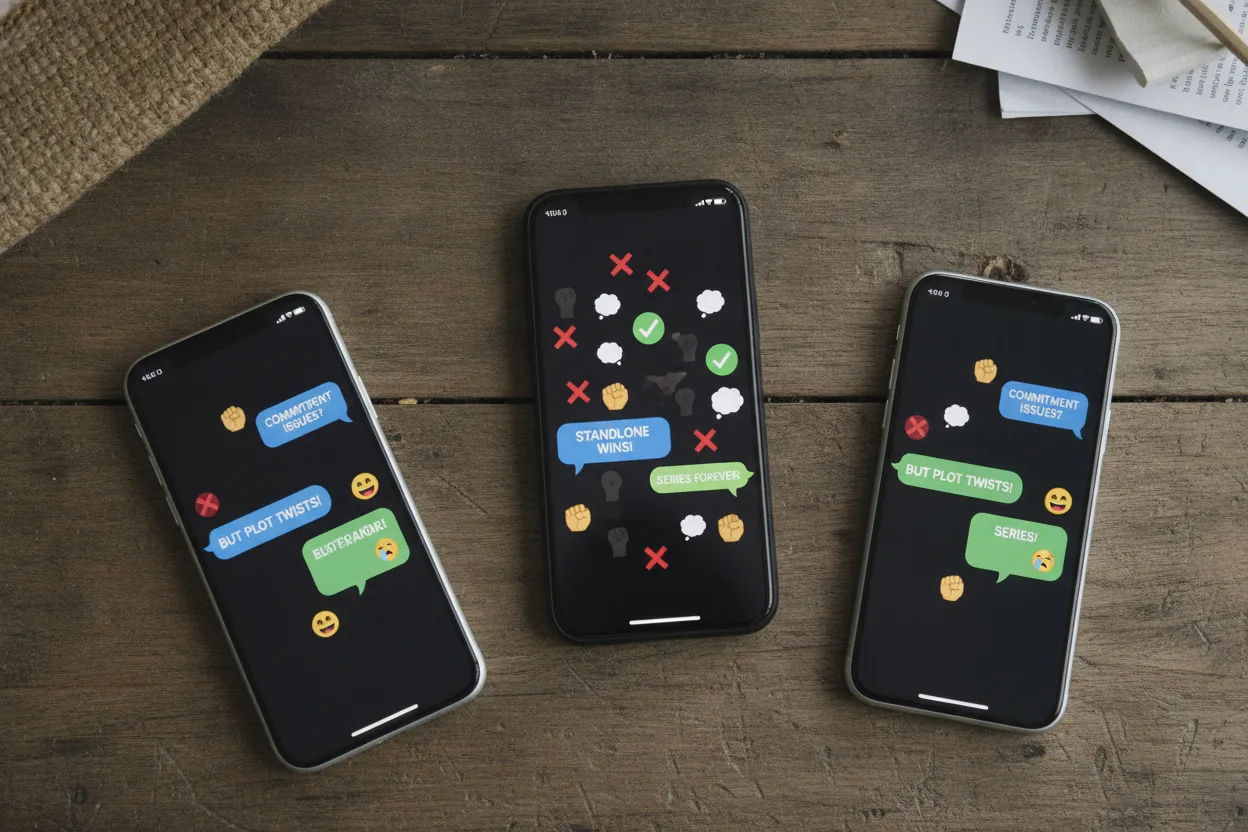
This is where the arguments get unhinged. Because the way BookTok frames recommendations has shifted dramatically, and it’s creating real friction between readers who prioritize different things.
On one side, you’ve got the standalone advocates. These are the readers who explicitly ask for standalone romantasy or short duology options so they don’t feel trapped if the vibe turns out to be wrong. They want [*Divine Rivals*](https://www.goodreads.com/book/show/62048680-divine-rivals), which is a complete duology with high romance weight and low fantasy difficulty — the kind of book where you can sink into the we-hate-each-other-until-we-don’t pipeline without needing a glossary or a character map. They want [*Uprooted*](https://www.goodreads.com/book/show/22544764-uprooted) by Naomi Novik, which delivers fantasy romance without a series obligation, a single self-contained story that hits hard and lets you go. They want [*One Dark Window*](https://www.goodreads.com/book/show/60228587-one-dark-window), a gothic beginner pick that’s also a complete duology, which makes it feel low-risk for readers testing the genre or coming off a bad series breakup.
These readers aren’t less invested. They’re not casual. They’re protecting their energy. And when BookTok is drowning you in new romantasy recs every single week, the ability to say “this one is two books and done” is genuinely valuable information. *A River Enchanted* sits in this camp too, positioned as a shorter duology for readers who want adult fantasy romance without a massive backlog or the pressure of keeping up with an ongoing release schedule.
On the other side, you’ve got the deep-dive loyalists. These are the readers who see [*Fourth Wing*](https://www.goodreads.com/book/show/61431922-fourth-wing) labeled as a fast, spicy entry point and immediately want to know: how many books will this be? Is Xaden’s arc going to develop across three more installments? Is this a world I can sink into for years? *Fourth Wing* is attractive precisely because it’s an ongoing series, but that also means the commitment is real. You’re signing up for a relationship with Rebecca Yarros’s release timeline. You’re joining a fandom that’s still being written. The excitement is real, but so is the risk that Book Three might not land the way Book One did, and by then you’re already in too deep to walk away clean.
Here’s the part that wrecks me about this divide: readers start throwing hands in the comments over it. You’ll see someone post a *Fourth Wing* rec and the replies split immediately — half the comments are “YES this ruined me in the best way” and the other half are “I refuse to start an unfinished series, I’ve been hurt, don’t ask me about *Kingkiller Chronicle*.” On Reddit, there are entire threads with titles like “I need to be institutionalized after that ending, someone tell me when Book 3 drops before I lose it.” On Goodreads, the one-star reviews aren’t even about quality — they’re from readers who feel personally betrayed by a cliffhanger they weren’t warned about. One reviewer literally wrote: “Five stars for the story, one star for leaving me like this with no release date. I can’t do this again.” That mess, that unfiltered chaos, is the real texture of this conversation.
[*The Serpent and the Wings of Night*](https://www.goodreads.com/book/show/60617238-the-serpent-the-wings-of-night) creates an interesting middle ground. Its central arc is shorter, but the wider world continues in subsequent books, which means you get a satisfying core love story without the same sprawling investment as something like *Throne of Glass*, but you also can’t fully pretend it’s a standalone experience. It’s a gateway drug disguised as a finished meal.
The Catharsis: Naming What You Actually Need

Here’s what I think the romantasy commitment level debate is really about, underneath all the practical logistics of “how many books” and “is it finished.” It’s about readiness.
When you pick up a romantasy, you’re not just choosing a plot. You’re choosing how vulnerable you want to be, how long you want to stay in that vulnerability, and whether you trust this author to hold your heart carefully through the entire journey. That’s an enormous amount of trust to extend, especially to a series you haven’t started yet, based on a thirty-second BookTok video with a trending sound and some annotated page spreads.
The readers who ask “is it worth starting now” are really asking “will this hurt me in a way I can recover from?” And the ones who say “I only read completed series” are really saying “I’ve been hurt before and I need to know this story respects my time and my heart.” These aren’t shallow preferences. They’re boundaries. They’re the same instincts that make us reread [*Ice Planet Barbarians*](https://www.goodreads.com/series/135015-ice-planet-barbarians) during bad weeks, because we already know how that journey ends, and sometimes you need the certainty of a guaranteed safe landing.
The catharsis comes when you find the right match. When you pick up a duology that’s exactly the level of investment you needed, and it delivers a complete arc with an enemies-to-lovers tension so perfectly calibrated that you feel both devastated and healed by the last page. Or when you deliberately choose the eight-book series knowing full well you’re about to lose months of your life to it, and you do it anyway because the first chapter grabs you by the throat and you recognize the feeling. You know this one is going to matter. You know you’re going to build the board, join the chaos, have opinions that feel personal because they are personal.
Community-Native Love: How We Actually Talk About This
What I love about the way this conversation happens in our spaces is that nobody’s pretending to be objective about it. Nobody’s writing a measured literary analysis of whether series fiction represents a superior narrative structure. We’re in the comments saying things like “I can’t start another unfinished series, my therapist and I have discussed this” and “honestly if the slow burn doesn’t start developing until Book Three I need someone to just tell me that upfront so I can prepare myself.”
That’s real. That’s the language of people who understand that reading romantasy is not a passive hobby. It’s an active practice. It’s the way we process desire and conflict and tenderness and rage and the specific ache of wanting someone who’s supposed to be your enemy but whose hand just brushed yours in the dark and now the entire trajectory of your life has changed.
BookTok’s dominance in the romantasy space has made the whole how-deep-am-I-going question louder, because the platform thrives on quick hits — a thirty-second clip of someone sobbing over a final chapter gets more traction than any thoughtful review. A sixty-second video can make you desperate to read a book, but it can’t tell you whether that book is the beginning of a three-month life takeover or a single transcendent weekend. So readers have started demanding that information upfront. One BookTok creator put it perfectly: “I love you all but if you recommend me a series, you NEED to tell me if it’s finished. I am not doing this to myself again.” The creators who provide that context are building the most trusted recommendation channels in the space.
The spoiler risk dimension matters here too. Readers want to know whether a book is a clean entry point or whether understanding the stakes requires knowledge from previous installments. They want to know if the spice evolves across books, because starting a series where the tension doesn’t pay off until Book Three is a fundamentally different experience than one where the first installment delivers a complete romantic arc. They want to know about cliffhangers, because a cliffhanger at the end of a completed series is a very different event than a cliffhanger at the end of a book whose sequel doesn’t have a release date.
Completed Romantasy Series: Three That Reward the Deep Dive
Because this is Romantasy Refuge and we don’t do things halfway, let’s talk about how the investment question plays out across three specific series that sit at different points on the spectrum — each one complete, each one earned.
First, [*Captive Prince* by C.S. Pacat](https://www.goodreads.com/series/93758-captive-prince). This is a completed trilogy, which makes it one of the most satisfying high-investment reads in the MM enemies-to-lovers space. The tension between Damen and Laurent is the kind of slow, excruciating build that rewards every single page — particularly the moment in [*Kings Rising*](https://www.goodreads.com/book/show/18660669-kings-rising) where every power dynamic you thought you understood inverts completely, and the vulnerability that’s been buried under layers of political maneuvering finally breaks the surface. You know going in that it’s three books. You know it’s finished. And that knowledge lets you surrender to the tension completely, because you trust the landing is there. The power dynamics shift across all three books in ways that make rereads feel like entirely different experiences.
Second, *The Serpent and the Wings of Night*, which I mentioned earlier. While the core romance centers on Oraya and Raihn, the broader world and subsequent books open the door to more complex relationship dynamics and the kind of found-family bonds that hit deep notes even when the central pairing is MF. The investment here is moderate. You can read the first duology as a relatively self-contained experience, but the world pulls you deeper if you let it.
Third, [*Bonds of Brass* by Emily Skrutskie](https://www.goodreads.com/book/show/43531907-bonds-of-brass). This is a space-opera-meets-fantasy-romance series with an MM core that carries some of the same power-imbalance, rivals-to-lovers, trust-as-currency dynamics that make fae court romances so addictive. It’s a trilogy, it’s complete, and the arc across all three books is the kind of journey where the investment pays off specifically because you’ve watched these characters earn every moment of vulnerability over hundreds of pages.
Each of these series represents a different point on the spectrum, and knowing where they fall before you start lets you choose based on what your heart can handle right now. Not what BookTok says is trending. Not what has the prettiest special edition. What you actually need.
Choosing How Deep You Go Is Choosing Yourself
The debate over romantasy commitment level isn’t going to resolve into a single answer, and it shouldn’t. Because the right answer changes depending on where you are. Coming off a devastating series finale that left you flattened? A standalone like *Uprooted* might be exactly the gentleness you need. Feeling restless and hungry for something that’ll take over your entire identity for a season? *Throne of Glass*’s eight-book marathon is right there, waiting to become your whole personality.
The point isn’t to avoid going deep. The point is to choose it consciously. To know what you’re walking into before the first chapter grabs you, because once that enemies-to-lovers tension sets its hooks, you’re not making rational decisions anymore. You’re reading at 3 a.m. with your phone brightness on the lowest setting, telling yourself “one more chapter” like it’s not already dawn. You’re already committed. The only question is whether you chose it or it chose you.
And if that sounds familiar — if you’re remembering the exact moment Cardan said the thing and your whole understanding of the story cracked open and rearranged itself — then you already know what I mean. You already know that the commitment level question isn’t really about logistics. It’s about recognizing that the books that wreck you the hardest are the ones you walked into with your whole chest, knowing full well what they’d do to you.
So the next time a book goes viral and your entire feed is screaming about it, before you one-click, ask the questions that matter. Is it standalone or series? Is the series complete? How many books before the romantic payoff? Does it end on a cliffhanger? Is the spice front-loaded or does it build? These aren’t spoilers. They’re survival tools. And in a genre built on intensity, knowing your own limits is the most powerful thing you can do.
Because you deserve a reading experience that matches your capacity. Whether that’s a single perfect night with a fae lord who never needed a sequel, or a years-long devotion to a world so vast and achingly rendered that leaving it feels like a breakup. Both are valid. Both are love. And this community will be here for you either way — in the comments, in the group chats, on the boards we build at midnight with shaking hands and full hearts, debating whether the ship is canon-compatible and knowing in our bones that it doesn’t matter what’s canon. What matters is what’s ours.