
Spice Without Soul Is Just Choreography
*”He didn’t touch her like he wanted her. He touched her like he was terrified of what would happen when he admitted how long he’d wanted her.” — not a real quote, just the energy*
That’s the exact emotional frequency that hums through the best MMF fae romances right now and makes earned spice in romantasy hit different from anything else on your shelf. It’s the vibe radiating through C.L. Laudine’s *Bound by Fury and Flame*, the series that had its hooks in me so deep I wasn’t coming back up for air. Not because it was explicit. Not because the encounter was choreographed with some kind of acrobatic precision. Because the tension had been building since chapter three, and by the time these three characters finally collided, it felt like the story itself exhaled. I read that moment at 2 a.m. on a Tuesday, texted my group chat “I am not okay,” and then immediately flipped back to reread it because the heat hits different when you’ve been starving for it alongside the characters.
And that’s the conversation right now. Not whether we want heat. We want heat. We’ve always wanted heat. The conversation in 2026 is whether the intimacy is doing something or just sitting there looking pretty on the page.
Why “Heat Without Heart” Is Losing Its Grip
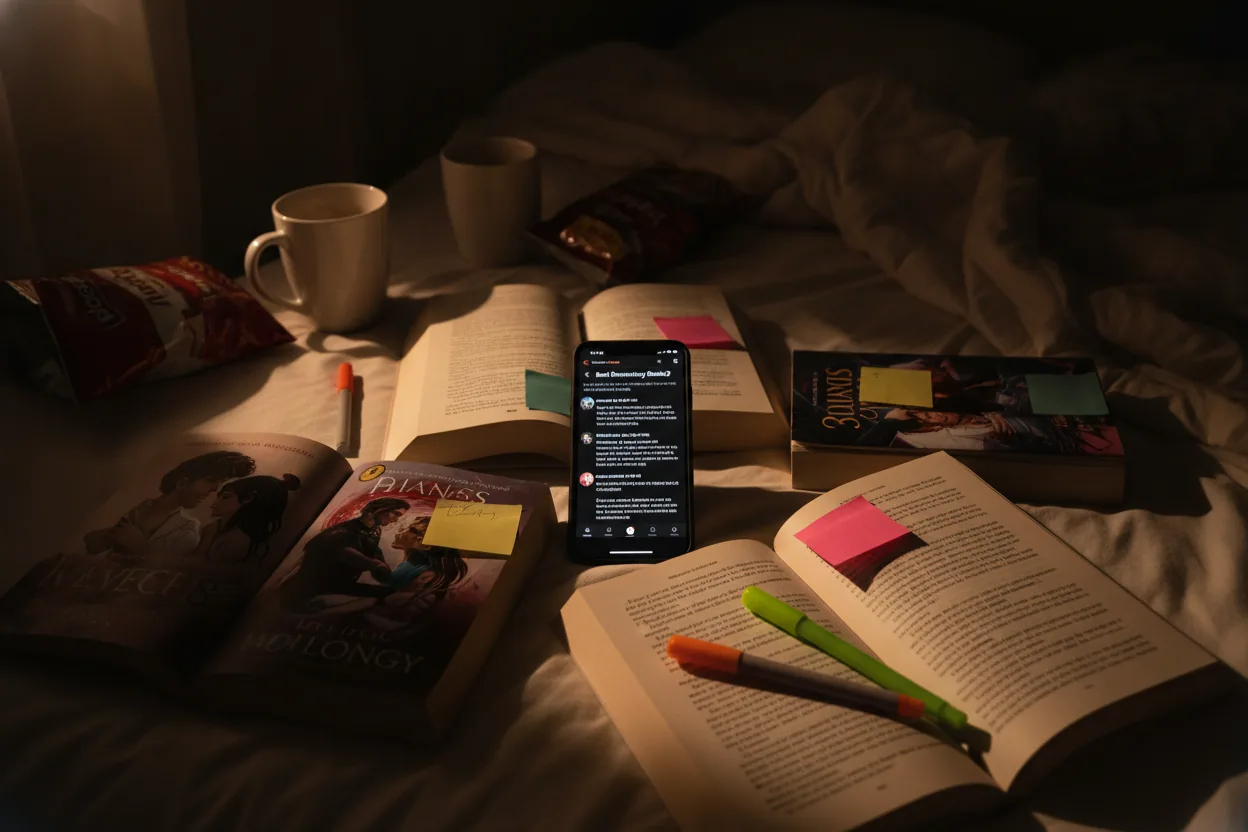
You’ve seen it happening in real time — in every BookTok comment section, every Goodreads review thread, every group chat screenshot that ends up on someone’s story — readers aren’t just rating spice levels anymore. They’re interrogating why the heat exists.
A year ago, you could recommend a book by saying “five pepper rating, open door, absolutely unhinged.” And people would click. They’d add to cart. They’d read. But something shifted. The books that are actually breaking through right now — the ones generating the kind of feral devotion that turns a series into a personality trait — are the ones where readers say things like “I did not expect to *feel* this” or “the tension before the encounter wrecked me harder than the encounter itself.”
That’s not a rejection of spice. That’s an elevation of it.
Look at the discourse around [*Zodiac Academy*](https://www.goodreads.com/series/262878-zodiac-academy) — half the fandom wars aren’t about whether the steam is hot enough, they’re about whether specific moments earned their emotional weight or just showed up because it was time for a set piece. The same split fueled the [*Captive Prince*](https://www.goodreads.com/series/93872-captive-prince) renaissance on BookTok last year, where creators like [@neph.reads](https://www.tiktok.com/@neph.reads) broke down beat by beat how Pacat made readers wait so long for physical intimacy that the eventual payoff rewired people’s entire expectations for the genre. That’s not an accident. That’s craft.
I keep seeing readers describe the difference between books that have explicit content and books where the intimacy changes the entire dynamic of the relationship. One adds heat. The other advances the arc. And we can feel the difference. We’ve always been able to feel it. We just didn’t have the shared language for it until BookTok turned scene-level discourse into a collaborative sport.
Think about the books you’ve reread this year. Not the ones you read once and shelved. The ones you dog-eared, annotated, screenshotted and posted with a shaky-handed caption. I’d bet money the pages you keep going back to aren’t the most explicit ones. They’re the ones where something between the characters fundamentally shifted. Where vulnerability cracked open something that the plot alone couldn’t reach.
The Build-Up Is the Whole Point

Here’s the thing that might get me roasted: I have skimmed spicy scenes. I have. In books where I didn’t care about the ship, where the tension hadn’t earned the payoff, where two characters went from bickering in one chapter to tangled up in the next with no bridge between them. My eyes glazed. I flipped ahead. I felt nothing.
But give me 250 pages of earned tension? Give me a fae lord who won’t let himself touch the person he’s been protecting because he knows the second he does, his entire political alliance crumbles? Give me an MMF dynamic where two of the three have history and the third is watching that history with a hunger they don’t have words for yet? Give me characters who orbit each other for chapters, who fight because it’s safer than admitting what the proximity is doing to them?
Then when it happens, I’m not reading it. I’m living in it.
That’s what the 2026 booklists keep circling back to. The roundups that are actually resonating aren’t ranking books by steam level. They’re ranking books by emotional build. By how long the tension simmers. By whether the anticipation itself feels like foreplay for the reader, not just the characters.
K.A. Linde’s [*House of Dragons*](https://www.goodreads.com/book/show/58896662-house-of-dragons) series did this thing where the first physical contact between the leads wasn’t even romantic. It was a hand on a wound during a healing sequence, written with so much restrained wanting that the tension practically hummed off the page. I had to put my Kindle down and stare at the ceiling. That moment had zero explicit content, and it burned hotter than half the open-door encounters I’ve read this year, because the emotional architecture was already there. The steam didn’t need to carry the weight. It just needed to land.
Intimacy That Advances the Arc Isn’t a Bonus — It’s the Standard Now

There’s a growing distinction in how readers talk about intimacy in romantasy, and it’s more specific than it used to be. It’s not just “open door vs. closed door” anymore. Readers are parsing the difference between encounters that are explicit, encounters that are emotionally rich, and encounters that are both. And they want both. They’re not settling.
I’ve seen threads where people break down individual moments and ask: “Did this change the relationship?” That’s the question. Not “was it hot?” Not “how many pages?” The question is whether the intimacy functioned as a narrative turning point. Did it reveal something about a character that dialogue alone couldn’t? Did it shift the power dynamic? Did it crack through a wall that one of them had been building since their backstory?
When the answer is yes, that’s the book people won’t shut up about. That’s the book that gets the “I’m going to need everyone to read this immediately” energy. That’s the book that generates the kind of ship discourse where people are dissecting the emotional mechanics of a single glance across a war council table because they know what that glance means now, after the moment that changed everything.
The most acclaimed spicy romantasy of 2026 so far shares a common thread: the intimate sequences are doing double duty. They’re hot, yes. But they’re also plot. They’re also character development. They’re also the moment where trust gets tested, or trauma gets confronted, or a lie unravels because you can’t hide from someone when you’re that close to them.
That’s earned spice. That’s what readers are rewarding.
The Fae Trauma Moment That Broke My Whole Reading Queue

I need to talk about a specific thing that happened in my reading life this year because it perfectly illustrates why this conversation matters.
I was deep into an MMF fae court series — [*The Bonds That Burn Us*](https://www.goodreads.com/series/367924-the-bonds-that-burn-us) by Jeneane O’Riley. Three books in. The dynamic between the three leads had been this slow, devastating orbit of jealousy and loyalty and unspoken need. One of them had a trauma arc tied to their magic — this idea that every time they used their power, it cost them a memory. And the other two knew. They’d been watching this person lose pieces of themselves for the sake of the court, and the tension wasn’t just romantic. It was existential. It was grief wrapped in desire wrapped in the terror of loving someone who’s disappearing.
The moment that broke me wasn’t the first intimate one in the series. It was the one in book three where, mid-encounter, one of them said a name. A name the third character had forgotten. And the recognition on their face — the way the author described the instant where pleasure and memory and loss all collided in the same breath — I sobbed. Actively sobbed. During a sequence that was, by any metric, extremely explicit.
That’s what emotionally integrated heat does. It doesn’t just make you feel desire. It makes you feel everything. It uses the intimacy as a vehicle for the emotional payload the entire series has been building toward. And when it lands, it lands in your chest, not just your pulse.
I’ve been chasing that feeling in every book since. And I’m not alone. The readers driving 2026 discourse aren’t looking for more steam. They’re looking for heat that hurts in the best way.
The Twist That Redefines What Tension Can Be
Let me tell you about the twist I didn’t see coming — the one that reframed every heated encounter before it.
In the same series, there’s a revelation in the final act of book three. One of the three leads has been under a compulsion. Not during the intimate moments — nothing that violates consent — but a compulsion that altered how they perceived their own emotions. They thought they were falling in love. They were. But the compulsion was amplifying it, distorting the timeline, making them feel things faster and more intensely than they naturally would have.
When the compulsion breaks, the most devastating thing happens: the feelings don’t go away. They just become quieter. Realer. And the character has to sit with the knowledge that what they felt was true, but the volume was wrong. And what follows — where the three of them have to rebuild the physical dynamic from scratch, slowly, tentatively, with all the raw edges exposed — is the most earned piece of intimacy I’ve ever read.
Because the author didn’t just write a twist. They wrote a reason for the closeness to start over. To mean something different the second time. To require more vulnerability than the first time, even though the first time was already vulnerable. That’s the kind of tension payoff that makes you rethink every romantasy you’ve ever read and ask: was the heat in that book doing this much work? Or was it just there?
Why Emotional Devastation and Explicit Heat Belong Together
There’s a reason the books hitting hardest right now are the ones pairing emotional devastation with explicit content. It’s not because readers are masochists (okay, some of us are, but that’s a different article). It’s because the combination creates an intensity that neither element achieves alone.
Think about it. A purely emotional moment can be devastating, but it stays in your head. A purely explicit encounter can be thrilling, but it stays on the surface. When you merge them — when a character is breaking open emotionally while also being physically intimate with someone they’ve been fighting their feelings for across three hundred pages and a blood oath — the reader experiences something that lives in both places at once. Head and body. Heart and heat. That’s the reading experience people are describing when they say they “felt it everywhere.”
And that’s what BookTok is rewarding. Not explicitness as a feature. Explicitness as a consequence of emotional honesty. Heat that exists because these characters have finally stopped lying to themselves, and the physical expression of that truth is the only language left.
The community shorthand has gotten so much more specific this year. I love it. Readers aren’t just asking “is it spicy?” They’re asking “does the steam advance the ship?” They’re asking “is the tension resolved through the intimacy or just interrupted by it?” Creators like [@romantasyreader](https://www.tiktok.com/@romantasyreader) and [@faboredreader](https://www.tiktok.com/@faboredreader) are crowdsourcing emotional expectations at the page level because their audiences have been burned before by books that promised heat and delivered choreography.
We deserve better than choreography. We deserve spice that knows our names.
My Top Three MMF Fantasy Series Where Heat Feels Earned
I promised a ranking and I’m delivering, but know that this list cost me sleep, friendships, and at least one phone charger I forgot to plug in because I was too busy reading.
First: [*The Bonds That Burn Us*](https://www.goodreads.com/series/367924-the-bonds-that-burn-us) by Jeneane O’Riley. The series I’ve been confessing about this entire article. The memory-loss magic system, the fae court politics, the way all three leads need each other for completely different reasons and the intimacy reflects that asymmetry every single time. This one sits at the top because no other series has made me feel so completely wrecked by a moment that was simultaneously the hottest and saddest thing I’ve ever read. The way O’Riley layers loss into desire — where a forgotten name becomes the most devastating thing anyone’s ever said mid-breath — that’s not just spice. That’s a weapon aimed directly at your emotional infrastructure, and she does not miss.
Second: [*Captive Prince*](https://www.goodreads.com/series/93872-captive-prince) by C.S. Pacat. Not MMF, but the gold standard for what earned tension looks like in practice. The entire first book is a masterclass in two people pretending they’re not watching each other with a kind of hunger that rewires the tension of every interaction they share. The build-up across the trilogy is criminal. The payoff is worth the wait. And the intimate moments in the later books feel like emotional archaeology — like the characters are uncovering parts of themselves they buried long before the story started. Pacat understood something that most authors are only now catching up to: the restraint is the foreplay. The hundreds of pages where they don’t touch are doing more work than the pages where they finally do, because by the time they get there, you feel every single one of those withheld moments landing at once.
Third: [*Bound by Fury and Flame*](https://www.goodreads.com/book/show/200965508-bound-by-fury-and-flame) by C.L. Laudine. The one with the morally gray fae general, the human diplomat who’s too smart for their own good, and the healer who’s been quietly holding both of them together while falling apart. This series does something I haven’t seen anywhere else: the most intense encounter in the entire trilogy is also the one where the biggest plot twist drops. Laudine wove revelation and intimacy so tightly together that you can’t separate the emotional impact from the physical one. You’re gasping for two completely different reasons on the same page, and that double-hit of vulnerability and truth rewires how you process every chapter that came before it. It’s brutal. It’s brilliant. It’s the kind of earned spice that makes you evangelistic.
This Is What We’ve Been Asking For All Along
The 2026 romantasy landscape isn’t rejecting spice. It’s refining what spice means. Readers have always known the difference between heat that lands and heat that doesn’t. We just finally have the platforms, the language, and the collective willingness to say out loud: we want the moment to matter. We want the tension to earn the release. We want to feel like the characters couldn’t have arrived at this point any other way, and that’s exactly why it’s devastating.
Earned spice isn’t a trend. It’s a standard. And every romantasy author who understands that the build-up is foreplay, that vulnerability is the hottest thing a character can offer, that a well-placed hand on a wound can outperform an entire chapter of explicit content if the emotional foundation is there — those are the authors whose books we’re annotating, screenshotting, and refusing to lend out because we need them within arm’s reach at all times.
If you’re looking for where to start, check out our [MMF fae court series recommendations](/three-mmf-fae-court-series-where-love-breaks-thrones) or our breakdown of [what makes safety chemistry the new standard for intimacy in romantasy](/safety-chemistry-new-spice). The books are out there. The ones that will ruin you in the best possible way.
The heat means nothing if it isn’t earned first. But when it is? When the spice and the heart arrive together, tangled up in each other, impossible to separate?
That’s not just a good page. That’s the reason we read.