
Safety Chemistry Is the Reason You Reread That Chapter
There’s a moment in Sarah J. Maas’s *A Court of Mist and Fury* — you know the one — where Rhysand doesn’t push. Feyre is shattered, hollowed out, and instead of demanding she fight or heal or perform recovery on his timeline, he simply makes sure she eats. He gives her space and paint and a room with a view. He stays close enough to catch her but far enough that she can breathe. That moment is what made me realize I’d been reading protectiveness wrong my entire life. Not because Rhys doesn’t also have the power to level a battlefield. But because the scene that lives in my body isn’t the one where he fights. It’s the one where he *stays*. And staying — whether you first felt it through Rhysand, through Raihn in Carissa Broadbent’s *The Serpent and the Wings of Night*, or through Cardan’s devastating final-act choices in Holly Black’s *The Folk of the Air* — is becoming the act that actually wrecks us. What I now think of as safety chemistry.
Let me tell you about the shift. Let me tell you why it matters. And let me tell you why the protective MMC you’re bookmarking on TikTok right now probably doesn’t look like the one you were bookmarking two years ago.
Why Protective MMCs Feel Different Now
Here’s what I keep seeing in comment sections, in group chats, in the unhinged annotations my friends send me at 1 a.m. The conversation around protective heroes has moved. It’s not that readers stopped wanting the “who did this to you” moment. That moment is still sacred. It still makes the back of your neck prickle. But the energy around it has changed. Readers aren’t just chasing the explosion anymore. They’re chasing the exhale after it.
Two years ago, the dominant BookTok clip was the protective MMC losing it. Going feral. Walls cracking. Magic surging. The clip that got the saves was the hero at his most volatile, his most uncontrolled, his most terrifyingly intense. And that was gorgeous. I’m not burying it. But what I see readers saving now, reposting now, stitching now, is the scene that comes after.
The hero checking the heroine’s wound with hands that are shaking because he’s still afraid. The hero sleeping in front of her door, not because he’s territorial, but because he can’t close his eyes unless he knows she’s breathing. The hero who notices she hasn’t eaten, and doesn’t demand she eat, but silently sets food next to her and leaves the room so she doesn’t feel watched.
That’s safety chemistry. That’s the thing that’s replacing danger chemistry as the primary reader satisfaction in protector archetype arcs. And it hits different because it’s not asking you to admire the hero’s power. It’s asking you to trust his attention.
The Hurt/Comfort Engine and Why It Never Burns Out

Hurt/comfort has been a durable trope across every romance subgenre for decades. It shows up in fanfiction. It shows up in trad-pub. It shows up in indie romantasy with custom character art and Etsy-sold annotation kits. But the specific flavor of hurt/comfort that’s dominating reader conversation right now has a very particular texture.
It’s not just “she gets injured and he carries her.” It’s the emotional decompression scene. The aftermath. The recovery chapter that some authors treat as a breath between plot beats and that other authors treat as the entire emotional climax of the book. Readers are gravitating, hard, toward the second approach.
Think about the scene in Carissa Broadbent’s *The Serpent and the Wings of Night* where Raihn tends to Oraya’s injuries after a trial — not with dramatic declarations but with steady hands and silence that says more than dialogue ever could. Or the moment in Scarlett St. Clair’s *A Touch of Darkness* when Hades doesn’t try to fix Persephone’s pain but simply sits with it, present and unflinching. Or that devastating chapter in *A Court of Mist and Fury* where Rhysand runs Feyre a bath and talks about nothing while she comes back to herself. These are the passages readers are highlighting, screenshotting, putting in their stories with the shaky-hands emoji. It’s not the fight. It’s the after-the-fight tenderness that signals, unmistakably, that this hero is a person the heroine can collapse in front of without losing anything.
And this is where hurt/comfort crosses into something deeper than trope. You re-read that one chapter when your real life is falling apart because it puts something back in place. The guardian hero makes the fictional world safe. And through him, you access a version of care you might be craving in ways you don’t fully articulate outside of a “this book fixed me” TikTok.
I’ve seen threads where readers describe specific hurt/comfort scenes as “the reason I slept through the night for the first time in weeks.” That’s not hyperbole. That’s what safety chemistry does. It’s not about adrenaline. It’s about nervous-system settling. And authors who understand this are writing the most rereadable books on the market right now.
Rhysand, Hunt Athalar, and the Protective Arc That Broke the Mold

Let’s talk about the heroes who are actually defining this conversation. Because the spectrum of protectiveness readers are debating and dissecting lives in specific characters, specific moments, specific books.
Rhysand’s arc with Feyre across the ACOTAR series doesn’t follow the expected trajectory where the “enemy” phase is all snarl and the “lover” phase is all softness. The tension lives in the middle — in the space where he’s already shielding her but she doesn’t trust it yet, and neither does the reader. That ambiguity is where safety chemistry gets its teeth. Because the question isn’t “will he guard her?” The question is “does his protection come from a place that will actually make her safer, or just more dependent?”
Maas plays with this. And the turning point isn’t a battle sequence. It’s the slow accumulation of small acts — Rhys adjusting, accommodating, creating space without announcing it. Feyre notices. The reader notices. And in that noticing, the entire dynamic reshapes itself.
Hunt Athalar in *House of Earth and Blood* does something similar but from a different angle. His protectiveness toward Bryce starts as obligation and shifts into something that terrifies him precisely because it’s no longer strategic. There’s a moment where he’s not guarding her from a threat. He’s just *there*, solid and warm and refusing to leave, and Bryce — who has spent the entire book performing invulnerability — lets one crack show. That’s the scene readers annotate until the page is more ink than text.
And then there’s Raihn in *The Serpent and the Wings of Night*, who might be the purest example of the new protective MMC template. His confession to Oraya isn’t “I’ll destroy anyone who touches you.” It’s closer to “I don’t need you to be unbreakable. I need you to let me be the place where you break.” That energy — quiet, unperformative, devastatingly steady — is the kind of emotionally charged moment readers are clipping, annotating, and turning into fan art. It’s not a declaration of war against her enemies. It’s a declaration of availability. Of steadiness. Of the willingness to witness her at her worst without flinching.
And that’s the confession template defining the current era. Not “I’ll kill anyone who touches you.” Not “you’re mine.” But “I’m here. I’ll stay here. You don’t have to earn it.”
The Spectrum from Steady Guardian to Obsessive Protector
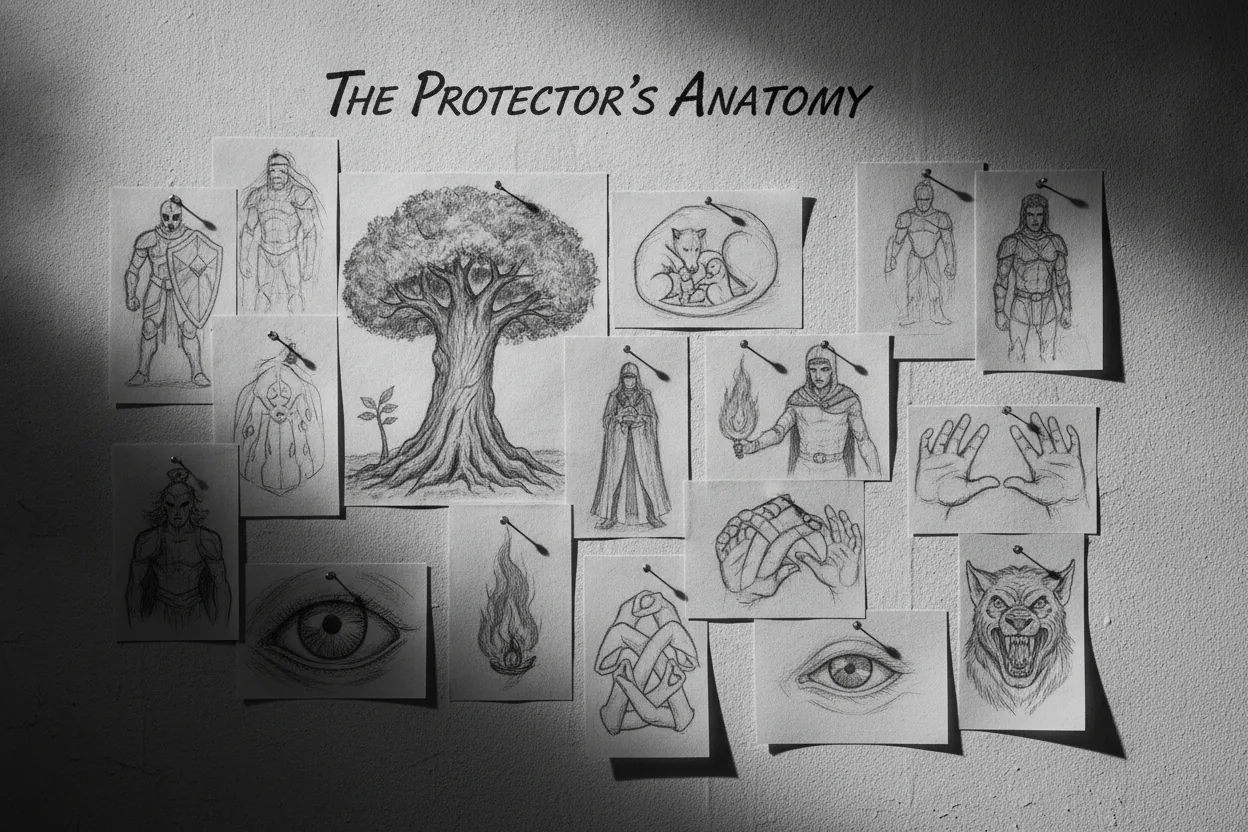
One of the most useful things happening in reader conversation right now is the acknowledgment that “protective MMC” is not a monolith. Readers are actively mapping a spectrum, and where a hero falls on that spectrum determines whether he reads as a comfort character or a red flag. Sometimes both. Sometimes that’s the point.
On one end, you’ve got the steady guardian. This is the hero who shows up through consistency. He doesn’t snap. He doesn’t rage. He just shows up. Every time. Without being asked. Without making it about himself. He checks the locks not because he’s paranoid but because it’s simply what he does before bed. He positions himself between the heroine and the door in a tavern without thinking about it. It’s muscle memory. It’s who he is. This hero appeals to readers who want reliability as romance, who find the sexiest thing a person can do is be fundamentally dependable. Think Rowan Whitethorn in the back half of *Heir of Fire* — before Aelin even wants him there, he’s already decided he’s not leaving.
Then you’ve got the caretaker. Slightly more active. This hero doesn’t just shield the heroine from external threats. He shields her from herself. He’s the one who sees her pushing past her limits and gently, sometimes firmly, intervenes. He brings the tea. He wraps the wound. He sits with her in silence when she can’t talk about what happened yet. The caretaker hero is hurt/comfort distilled into a character type, and he’s the one readers describe when they say “I need a book where he just takes care of her.” Raihn lives here. So does Rhysand in his best moments.
Then the rescuer. More dramatic. Higher stakes. This is the hero who arrives in the burning building, the collapsing dungeon, the courtroom where she’s been sentenced unjustly. The rescue itself is thrilling, but what makes this hero resonate in the current conversation is what he does after the rescue. Does he hover? Does he control? Or does he hand her the sword and say “I got you out. What happens next is yours to decide”? The after-rescue behavior is where readers are drawing the line between protectiveness and possessiveness now.
And then there’s the obsessive protector. The darkest end of the spectrum. This hero watches her sleep. Tracks her movements. Eliminates threats she doesn’t even know exist. In dark romantasy, this character is wildly popular — think the Darkling’s energy in *Shadow and Bone*, or Cardan’s more possessive moments in Holly Black’s *The Folk of the Air* series. But the discourse around him has shifted. Readers aren’t consuming him uncritically anymore. They’re asking: does his obsession serve her safety or his need for control? Is this devotion or surveillance? And the books that are winning the obsessive-protector space right now are the ones that let the heroine confront this question out loud, on the page, rather than glossing over it with a possessive kiss.
The Line Between Comfort and Control in Dark Romantasy
This is where the conversation gets genuinely interesting, and genuinely heated. Because in dark romantasy, the protective MMC often operates in a gray zone that readers love to argue about.
The possessive fae lord who locks his mate in a tower “for her own safety.” The morally gray assassin who kills her would-be abuser and then decides he’s the only one allowed to decide who gets near her. The cursed prince who keeps her close because proximity is the only way to keep the curse from killing them both, but the proximity also means she can’t leave, and he starts needing her presence for reasons that have nothing to do with magic.
Readers aren’t naive about these dynamics. They know the difference between fictional catharsis and real relationship red flags. But the discourse has gotten more sophisticated. Where three years ago a comment section might just say “he’s unhinged and I love it,” now you’ll see threads dissecting whether a particular act of guarding in a book signals that the hero sees the heroine as a person or as a possession. The language has changed. Readers are using terms like “autonomy-respecting protectiveness” and “consent-aware intensity.” They’re rewarding authors who can write a hero that’s dark and devoted without stripping the heroine of her agency.
This is the thing that makes you dog-ear the page — and the exact tension we live for here at Romantasy Refuge. The distinction between wholesome guardianship and territorial control isn’t just a content warning discussion. It’s a ship-compatibility debate. It’s the reason two readers can love the same book and disagree violently about whether the MMC’s behavior in chapter fourteen was romantic or horrifying. And both of them can be right, because the text supports both readings, and that ambiguity is part of the thrill. (If you want to go deeper on where your favorite heroes fall, we mapped the whole spectrum in our [protective MMC book list](/lists/protective-mmc-romantasy-books).)
Fan Theories That Prove Readers Are Thinking Deeper
The fan theory space around the protector archetype has evolved too. It’s not just “will they get together?” anymore. It’s structural. It’s psychological. And the theories I keep seeing circulate tell you everything about where readers’ heads are at right now.
The protectiveness is a trauma response, not a love language. Readers theorize that certain heroes guard so intensely because they’ve lost someone before, and the heroine is triggering their unprocessed grief. Look at how fans read Rhysand’s behavior toward Feyre through the lens of what happened Under the Mountain — his shielding of her isn’t just devotion, it’s a man who already failed to save someone and can’t survive it happening again. This reframes the behavior as sympathetic rather than controlling, and it gives readers a reason to root for the hero’s healing arc alongside the romance. It turns the MMC into a hurt/comfort recipient, not just a provider, and readers are starving for that reversal. As Reddit user u/nyx_reading_nook put it in an r/RomanceBooks thread: “Rhys isn’t overprotective because he’s possessive. He’s overprotective because he watched people die while he was powerless, and Feyre is the first person he can’t rationalize losing. That’s not a red flag, that’s PTSD.”
The protectiveness will become the central conflict, not just a feature. Readers predict that in sequel arcs, the hero’s need to shield will clash with the heroine’s growing power, and the relationship will have to renegotiate its entire dynamic. This theory shows up constantly in ACOTAR discussions about Nesta’s arc, in *The Serpent and the Wings of Night* sequel speculation, in any series where the heroine is on a power-escalation trajectory. Readers want to see the moment where she doesn’t need his protection anymore and he has to figure out what his love looks like without it. One Goodreads reviewer (@romantasy_wreck, 5-star review of *The Ashes and the Star-Cursed King*) wrote: “Raihn having to learn that loving Oraya means letting her be dangerous is the most compelling character work I’ve read this year. The protector who has to let go or lose her? THAT’S the sequel arc I want everywhere.” On TikTok, a viral stitch by @faebookshelf captioned it even more bluntly: “the moment the FMC outgrows his protection and he has to decide if he loves HER or loves being NEEDED — that’s where the real story starts.”
The protectiveness is actually the fae bond talking, and the hero doesn’t know it yet. This one is specific to romantasy, and it’s everywhere. The idea that the hero’s compulsive need to guard, shelter, and watch over the heroine isn’t a personality trait but a magical imperative. Readers love debating whether this makes the devotion more romantic (because it’s fate) or less (because it removes choice). And the best authors — Maas, Broadbent, Aster — leave this ambiguous long enough that the fan theory ecosystem can thrive. (We dug into the bond mechanics and what they mean for Rhysand’s arc specifically in our [ACOMAF deep-dive](/deep-dives/acomaf-rhysand-feyre-bond) — fair warning, it’s a rabbit hole.)
Why Safety Chemistry Is Winning the Reread War
What trope-demand data won’t tell you but your reading habits will: danger chemistry hooks you on the first read. Safety chemistry is what brings you back.
The scene where the hero snarls at the villain is exciting. But it’s not the scene you flip to when you’re having a terrible Wednesday and you need ten minutes inside a book that makes the world feel survivable. The scene you flip to is the one where he brushes her hair out of her face while she sleeps and whispers something so tender that the author probably cried writing it. The scene where she finally tells him the worst thing that ever happened to her and he doesn’t try to fix it. He just says “I’m glad you’re still here.”
That’s what readers mean when they say they want a protective MMC. They don’t just want a fighter. They want a witness. They want a character who makes the fictional world feel emotionally habitable. They want the romance to function as a shelter, not just a storm.
And the readers I talk to, the ones deep in the annotations and the ship debates and the 3 a.m. rereads, they aren’t confused about this. They’ve always known the difference between a hero who shields with his body and a hero who shields with his presence. They’re just finally seeing that distinction reflected in the books being published, the content being created, and the conversations being had. If this is your thing — if you just read this entire piece nodding — [we built a whole list of books that deliver exactly this energy](/lists/protective-mmc-romantasy-books), organized by where each hero falls on the guardian-to-obsessive spectrum.
Safety chemistry isn’t a softening of the genre. It’s a deepening. And the hero who stays isn’t fading from reader demand. He’s evolving. He’s learning to put the sword down and sit with her in the dark.
That’s the version readers are falling in love with now. That’s the version worth writing about. And honestly? That’s the version that’s been making me cry into my Kindle for the last six months, so I’m not exactly unbiased here. But you didn’t come to Romantasy Refuge for unbiased. You came here because you already know what you love. You just want someone to say it back to you in a way that feels like being understood.
So here it is. Your obsession with the hero who stays is not a phase. It’s not a trend cooling off. It’s the trope growing up, unmistakably and irreversibly, into something that matches the kind of love readers have always deserved to see on the page — steady, witnessing, brave enough to be soft. And it’s going to keep hitting this hard for a long, long time.